 The was an air of celebration as Judy, Katherine, Ann, Marion, Lynda and myself entered the classrooms at Burdett Coutts Year three classes headed by Sam and Sasha on Thursday 23rd of May.
It was time to review all the exciting sessions that had taken place over the previous five weeks and to see how the children had been inspired and to celebrate being a ‘Wriggle-room Writer’.
However, Lynda and I had a special mission. We had been tasked with writing a ‘celebratory song’ with each class. This was to be written, learned and performed in a 45 minute time slot.
We knew that a song –writing collaboration with twenty-seven children might prove a little tricky so since we were limited for time it was decided to move quickly to raise the energy level in the room so that ideas would flow spontaneously.
Lynda got the children on their feet to perform the ‘rage stomp’, that she had taught them on a previous visit, from her fabulous Sand Dancers’ books. I followed that up by teaching them a musical version of Spike Milligan’s Ning Nang Nong poem I had written for a show and very soon the energy level was ready for us to begin to write a song.
Since I am a songwriter, I am fairly used to collaborating with other songwriters. The usual way of proceeding is to have a few ideas that you put forward just to get the ball rolling. It is understood that the ideas can change second by second as new and better ideas form.
So with Lynda acting as scribe armed with a marker and white board and me perched on the side of a desk with a guitar we began by writing the chorus with the children.
This was easy….Wriggle Room., Wriggle Room writers….We are the Wriggle-room writers.
The tune really wrote itself …think ‘earworm’ with an annoying catchy tune. The whole class was singing it within minutes and it was time to write the verses.
By asking the children strategic questions and fielding their responses, the song somehow began to reveal itself. I suspect this was because we were magically sprinkled with fairy dust, given Lynda’s connections.
The children were absolutely brilliant and extremely pleased with their song so we recorded it very roughly on an MP3 (hear below) and we played it back to them. First mission accomplished.
This was not the end however. One little boy came up to me and said very seriously ‘This is ‘our’ song isn’t it, not anyone else’s song?’ I responded by saying of course it was their song.
It was a good question because Lynda and I had originally thought perhaps once we had developed a structure for the ‘ Wriggle-room Writer’ song with the first class that we would use it with the second class and perhaps just write some extra verses.
That wasn’t to be. No we began again and the next class wrote another completely different song. This time think ‘power ballad’ full of angst, longing, and passion to be ..yes you guessed it.. ‘ A Wriggle-room Writer’ of course! The children were delightful, imaginative and friendly and it was wonderful day. Thanks kids!
A Good Home for Books by Elizabeth Hawksley
I’ve now been the UK Children’s Book Editor for the Historical Novel Society Review for some months and overseen the children’s reviews for the November, February and May issues. It’s been very interesting; I like knowing what’s new in historical novels, and eight interested members of the HNS help with the reviewing.
What I hadn’t realized, though, was how the books would pile up. There are points when I can scarcely see the carpet in my study. OK, a number are waiting to be posted to reviewers, but that still leaves a pile which I’ve reviewed but don’t have room to keep, plus a few books which are unsuitable for reviewing (i.e. not really historical).
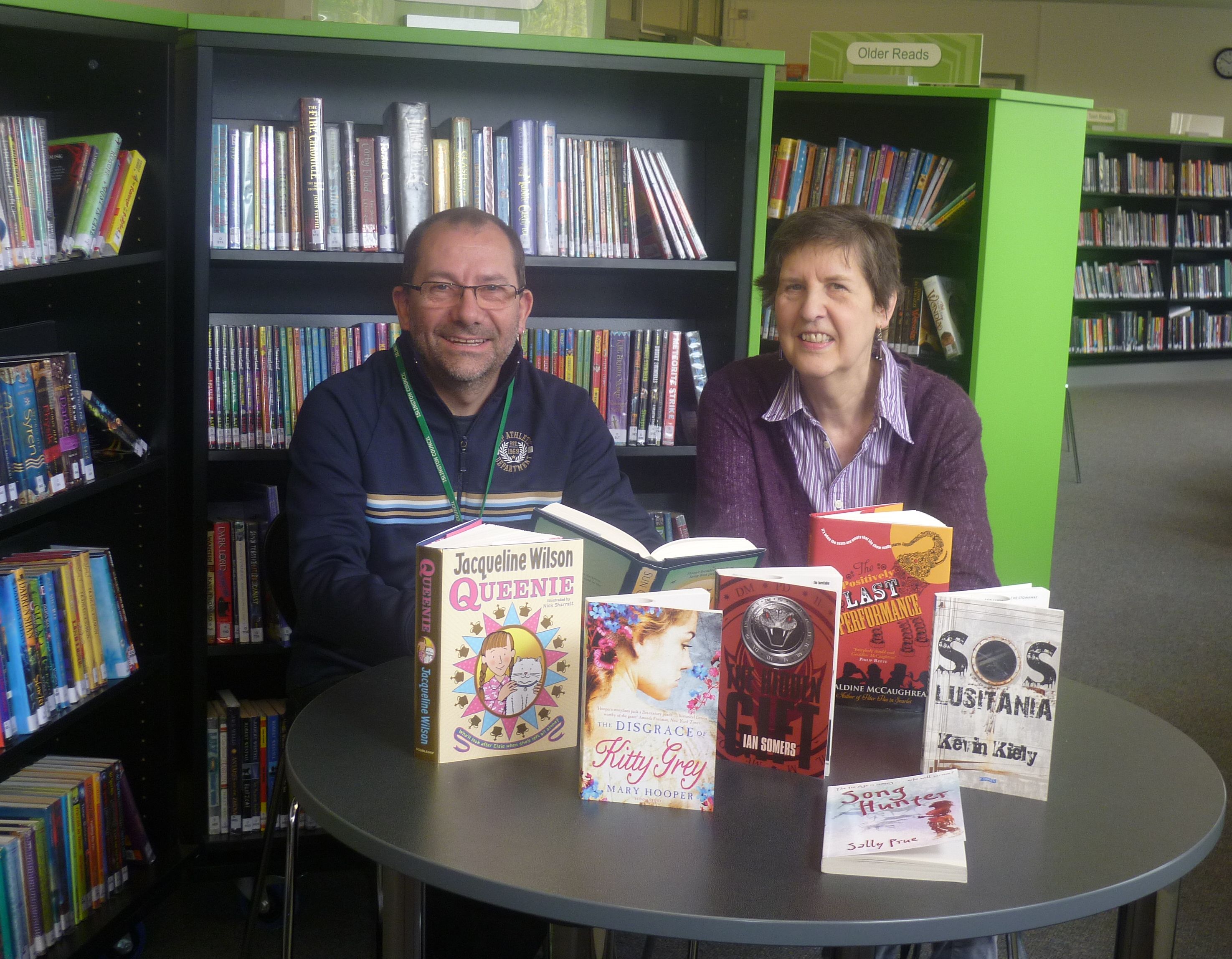
Tony Brown and Elizabeth Hawksley
What to do with them? I’m a great fan of public libraries and, in these cash-strapped times, they need all the support they can get. I emailed Tony Brown, the stock and reader development manager for Islington libraries, and explained the situation. All I wanted, I said, was for the books to go to a good home. Would he be interested?
Almost immediately, I got a reply. Yes, please. He’d be delighted to have them. So I parcelled them up, addressed it to Tony Brown, and staggered to my nearest library – there were a lot of books and they were heavy.
The May HNS Review has just come out, so a new pile of books need a good home. They are:
The Disgrace of Kitty Grey by Mary Hooper
SOS Lusitania by Kevin Kiely
The Positively Last Performance by Geraldine McCaughrean
Song Hunter by Sally Prue
Sun Catcher by Sheila Rance
The Hidden Gift by Ian Somers (the non-historical one which slipped through the net)
Queenie by Jacqueline Wilson
This time I did something different. I thought it would make an interesting blog, so I suggested to Tony that I bring them myself and say ‘Hello’. I’d bring my camera and perhaps a kind colleague could photograph us both, plus the books.
So here we are, in Islington Central children’s library.
However, that’s not the end of the story. There is an interesting sequel …
 Last week I had the pleasure of meeting the Year 3 classes from Burdett Coutts. These were the kids whose worryingly low literacy levels prompted the school to invite us in as writers in residence. I found both classes to be lively, focused and full of ideas. Our session was about Plot.
Whatever the piece of writing you are doing, it’s good to have a structure. So we began by reading “Georgie and the dragon” as an example of a quest story, and then looked at the usefulness of the number ‘three’. Three parts to a story – opening, middle and ending. And then, three obstacles or problems to give the middle of your story interest.
Before diving deep into planning their individual quest stories, both classes brainstormed a collection of action words that would help move their characters around, by land, sea and air. The resulting displays (to be continued) contained pooled vocabulary that was both useful and expressive.
We then played a game of two teams. The challenge was to invent some hair-raising problems and the ingenious solutions to them, that a character might meet on their journey. i don’t want to give too much away just yet, but some quite horrendous situations were devised along with some very imaginative ways round them…Year 3 are definitely the people I’d like to be stuck behind a spilled lorry load of cow dung with!
I gave the children some small books to plan out a complete story in and I’m really looking forward to seeing the amazing adventures that result. But judging by the sheer interest and enthusiasm that these children show, the best story of all may be that of their own journey and the challenges they will surely overcome.
Wriggle Room Writers – Session Two: Character
I did the second session at Burdett-Coutts, a week after Katharine Quarmby launched the six weeks of Wriggle Room Writers workshops with Year 3s.
My theme was character and we kicked off with all the students talking about who their favourite book characters are and why they like them. Lots of Roald Dahl characters popped up. No surprise there!
I introduced Eliot Jones, who is the main character in my picture book, Eliot Jones, Midnight Superhero and asked the children to pay attention to the adjectives and actions that I used to create the character and we talked about them after reading Eliot.
The rest of the session was based around the creation of their own superhero character, brainstorming characters and emphasising the fun of using alliteration and rhyme in the names of the characters. Some of the characters they came up with:
Toffee Softy – a girl with big hair who can capture baddies in her hair
Mr. Blingi Gadget – He has a big necklace with a medallion that opens up with a laser as well as numerous other gadgets
Big Belly Joe: Joe has a big soft belly and he can bounce around it and get places
Spyro
Mighty Mia
Singing Sophie or Super Singing Sophie whose loud voice could injure her enemies.
The children all started to develop their characters, drawing pictures, and describing them using great adjectives and actions which elaborated their charaters’ powers and characters. They began write some of their favourite adjectives and similes on cut out shapes to put up on a classroom display.
Taking their cue from Eliot, (a quiet boy with a huge imagination) they will hopefully let their imaginations go wild in the creation of their characters in their writing lesson, which will carry on the character work they started in this session.
I thoroughly enjoyed the ideas and enthusiasm the children brought to our sessions and, like Katharine, I’m really looking forward to reading their stories, creations, and favourite words later in the month!
— Anne Cottringer
I was lucky enough to kick off the first ever Wriggle Room workshop at the lovely Burdett Coutts Primary School down in Westminster. Wriggle Room is all about allowing children room to stretch in the curriculum – to have fun with words, rhyme, rhythm, character, song, develop a sense of how to build a story – and to use their senses
In this first workshop I spent about the first four to five minutes with both classes doing an observation exercise that both my mum, a primary school teacher, and an inspirational teacher from Halesworth she knew had done with classes. This was to get children to stand stock still and take in the world around them – cue Robert Louis Stevenson ‘What is life but full of care/we have no time to stand and stare?’ The first class quickly got the hang of it, on the school roof, and gazed up at aeroplanes and birds, heard workmen hammering and saw bees on flowers. The second group did the same exercise but in the school garden – cue lots of lovely observations about water creatures and flying things. We then spent about seven minutes writing about what the young writers had experienced, and I explained they could also write about any memories the observation had triggered, dreams they had remembered, and that they could use words from their mother tongue as well.
I then introduced the Wriggle Room Writers – and Islington Writers for Children. I talked about how we write (and illustrate) for different age groups of children and young people, about different topics and in different ways (from picture books, rhyming books, right up to novels for teenagers). I explained about how we have different starting points for writing and different ways of writing – but we all love writing and we know that there’s room for everybody to find their own way to write – that’s Wriggle Room and the children were now official writers too.
I then explained that over the next six weeks the children would be using their notebooks to write in (and they were all very pleased with their bright yellow notebooks). But first, they would be putting their ideas from the observation in a Magic Box (they had brought in boxes) and then in the next literacy class they would bring out those ideas and maybe add to them, with the aim of writing a nice rhyme, or a little sentence with lovely words in them, in their notebook. Big thanks here to the wonderful poet, Kit Wright, whose idea the Magic Box is – and The Poetry Society, and Anthony Wilson for sharing his ideas in their great workshop plans for schools. It’s a great way to get young writers to think about what words they can put in a magic box – their favourite words or phrases, and what they can get to rhyme with them. It got them thinking about rhymes, textures, sounds, smells, colours, dreams, and, of course, ways to think in and out of the box!
Then I explained that I was going to read Fussy Freya, my rhyming picture book, and some other poems that had inspired me to start writing. I explained that lots of picture books are in rhyme, or use rhythm and repetitions, all techniques that stem from poetry.
We then read Fussy Freya and then some poetry, which I left with the groups. The poems were selected to show how poets sometimes use form – rhyme, sometimes use repetition and sometimes use nonsense words to great effect. I explained that these poems were ones that had inspired me to write Fussy Freya and other books. I explained that other writers, such as Lynley Dodd, and Michael Rosen, who write picture books, also use poetry techniques in their work. I also selected them to show how poets are brilliant at using their senses to conjure up a real sense of presence – as are picture book writers.
I then read out a selection of poetry, from The Highwayman (rhyming couplets, sound), to The Oliphaunt (sound, couplets), to Ted Hughes’s The Thought Fox (free form, sight) – and haiku from the wonderful haiku master, Paul Conneally and a limerick from my dad, about steam cleaning versus the good old kettle and sponge – “Said the kettle to his partner the sponge/It’s time that we two took the plunge/Steam cleaning’s the game/So we’ll make it our claim/To banish all dirt, grease and gunge.”
The children loved the Ning Nang Nong song by Spike Milligan too – which I had to read out twice, to great hilarity.
We ended with their writing challenge – could they try and write something over the next six weeks in their notebooks? I explained that we would like, if their parents and the school were happy, to publish some on our website at the end of the six weeks. I, for one, am really looking forward to reading their poetry and all the other work they have been doing since, with the other writers from Wriggle Room.
Wriggle Room Writers by Marion Rose
The Evening Standard has highlighted London’s literacy problems in schools – sometimes shockingly – with statistics such as ‘one in three children is starting secondary school with a reading age as low as seven’. Its campaign to get children reading has been popular and successful.
So, when an email popped up from an inner London primary school seeking a writer in residence for its Year 3 classes, I was intrigued. The email said they were “looking for creative ways of investing in our children’s education, to inspire and motivate their writing.” Such a fresh, innovative approach should not be ignored I thought, but sadly I did not have the time. Would the school be interested, I asked tentatively, in having more than one writer share the residency?
The school leapt at the idea. And so did five other writers from Islington Writers for Children (the group behind this blog which has met fortnightly for 18 years to support each other’s writing). The fact that we, as published writers, are all totally different in our approach to writing suddenly made sense in terms of what we might offer kids.
Some of us work with a rough plot idea, some start from a character, others are inspired by an image, a name, or a sense of place. As individual writers in school, we would have the freedom to offer alternative ways in to writing, fun ways that might help kids doodle with ideas, and discover the fizz of pleasure there really can be in writing something that satisfies. (Yes really! One of the saddest questions I have ever been asked on a school visit is ‘Do you enjoy writing?’ accompanied by an astonished look.)
And so, the Wriggle Room Writers project has just begun. For six weeks this half term, a different children’s writer will spend half a day with two classes at Burdett Coutts & Townshend CE Primary. We hope it will create a buzz about reading as well as writing, and that it may stimulate interest beyond Y3. We’d like to learn from this project and do more residencies. And most of all – we look forward to featuring some of the children’s Wriggle Room writing on this blog, for everyone to see…
In Praise of Jacqueline Wilson by Elizabeth Hawksley
![queenie[1]](https://buzzaboutbooks.com/wp-content/uploads/2013/02/queenie1.jpg?w=300&h=422) One of the pleasures of taking over the children’s editorship for the Historical Novel Society Review recently has been discovering Jacqueline Wilson’s historical novels.
One of the pleasures of taking over the children’s editorship for the Historical Novel Society Review recently has been discovering Jacqueline Wilson’s historical novels.
I was lucky enough to hear her speak a few years ago, at a British Library event. Several children’s authors, including Jacqueline Wilson, were discussing Frances Hodgson Burnett’s The Secret Garden, one of my favourite books as a child. Unlike one of the other authors who airily dismissed Frances Hodgson Burnett as being of little account and, instead, talked about his own work, Jacqueline Wilson spoke intelligently and sympathetically about The Secret Garden. I awarded her a metaphorical gold star.
When her historical novels began to come through my letter box for review, I pounced on them eagerly and I have not been disappointed.
Her latest historical novel is Queenie. It’s set in 1953, Coronation year. Elsie Kettle lives with her Nan – her unreliable mother is a chorus girl and rarely at home – but Elsie doesn’t mind too much; Nan is her favourite person in all the world and they plan to see the coronation together. It will make up for the children and teachers at school who look down on her and make spiteful comments about her mother.
Then disaster strikes: both Nan and Elsie fall ill with TB. They are parted and Elsie is taken to the children’s ward of a Sanatorium and faces a painful treatment lasting at least eight months. How will she cope with the strict regime and no news from Nan? Her mother seldom visits and, when she does, she’s entirely self-centred.
However, there’s the beautiful snow-white ward cat, Queenie, who takes a special liking to Elsie; and Nurse Gabriel who’s so kind; and then Elsie discovers that she can tell stories that enthral the other children. For the first time in her life, she has real friends. And, as Coronation Day draws near, there is another surprise: the children’s ward will have a Very Special Visitor.
Jacqueline Wilson has the gift of being able to get inside a lonely child’s head. We experience both Elsie’s vulnerability and her stoicism. She’s matter of fact about her Mum and all the ‘uncles’ who come and go, but she also makes upsetting mistakes through ignorance and misunderstanding which get her into trouble.
An illegitimate child who lives with an ailing grandmother in poor circumstances is always going to be at a disadvantage, and Jacqueline Wilson doesn’t pull her punches. But she also knows what’s important: love. Elsie and Nan are very close, and, in her absence, Elsie comes to love Nurse Gabriel and Queenie. With love to help her through, we feel sure that Elsie will be all right.
I’m not surprised that Jacqueline Wilson’s books are so popular, nor that she holds Honorary Doctorates from a number of universities, is a former Children’s Laureate and was appointed D.B.E. for her services to children’s literature in 2008. She deserves it.
A Good Read by Elizabeth Hawksley
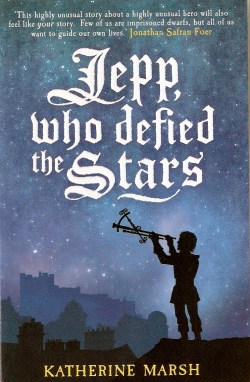
I hadn’t realized that there are so many new publishers out there. In the few months since I’ve taken over the UK Children’s Editorship for the Historical Novel Society Review, several new publishers have been in touch, asking if I’d be interested in reviewing their books. One of them was Hot Key Books.
They publish books for younger readers, 9-19 year olds, and pride themselves on publishing ‘something a little different, a little bit special’. This sounded interesting and I got in touch. A few days later, four books arrived, one of which was Katherine Marsh’s Jepp, who defied the Stars.
It is a most unusual story, set in the 1570s and based on fact. The book opens: Being a court dwarf is no easy task. I know because I failed at it. Fifteen-year-old Jepp, a dwarf, is taken from his village home to Brussels, then in the Spanish Netherlands, to the court of the Infanta Isabella. He is an intelligent boy with an interest in astronomy; surely he will be able to learn about astronomy there? But all the Infanta wants is a dwarf jester to amuse the court by his antics – like leaping out of a pie. Nobody notices his intelligence – he’s just a dwarf, nothing more.
He rebels and, as punishment, is sent to Uraniborg, the castle-cum-laboratory home of astronomer Tycho Brahe. Even here he is viewed as a mere servant. Can he convince Tycho that he has intelligence and something valuable to offer?
I loved the unusual hero and setting. Jepp (a real life character) isn’t just a 16th century dwarf, living at a time when most courts in Europe had dwarfs to entertain them, he is also Everyman. He has dreams he wants to follow; a girl he loves – but could she love him back? – and intelligence he longs to use. He wants, as we all do, to be master of his own fate but he constantly finds that people can’t see beyond his diminutive size.
Jepp, who defied the Stars, is not only an intelligent and thought-provoking book, it’s also refreshingly different and a terrific read.
My Weather Diary by Elizabeth Hawksley
When I was a teenager, someone gave me a five year diary. As each day was allotted only five lines, I decided it was useless, chucked it in a drawer and forgot about it.
Many years later, when I started writing historical novels, I discovered that if I wrote a winter scene in, say, August, I couldn’t remember exactly what being cold felt like. What plants, if any, were out in the garden, what birds were around, what was the temperature? I wasn’t sure. And it’s those little touches, like one’s ears going pink with cold and stinging, which brings one’s story alive.
Then I had a brainwave. I would use my five-year-diary and make notes over five years. What should I include? Daylight hours, for a start. I was brought up in the country and many of my stories have a country setting, so I needed to note the weather, the temperature – in Fahrenheit, of course – and what was going on. What birds were around? Had the dawn chorus started – or stopped? What stage were the trees at and what flowers were blooming? What was happening in the farming year?
I jotted down anything I thought would be useful to me as a novelist. For example, in October, I noted what date I started wearing gloves.
Today, December 21st, is the winter solstice; daylight hours in London are 8.04 am to 3.54 pm. (Up in the Shetlands, daylight lasts less than six hours.) This is what my weather diary notes for today over five years:
Year 1 43º F. Still cold. My jasmine very pretty. Good holly year – holly likes warmer winters, mistletoe prefers it cooler. Lime twigs glow red in the winter sun. Very low winter sun shines straight into my eyes.
Year 2 45º F. Bare trees show remains of large untidy magpie nests. N.B., in winter, birds roost in woods, not in their old nests. Robins and blackbirds looking good (finished moulting) and singing again.
Year 3 32º F. Very cold. Fog lingering – Dickensian. Hazel catkins emerging. Outside, my ears sting and my breath puffs like a dragon.
Year 4 41º F. Chilly. Dull but dry. Large orange cones on spruces. Little green crocus spikes up. Silver birches have small catkins.
Year 5 40º F. Bloody cold. Wind from east makes my eyes water. Fallow deer and young run round in rings – playing? Black ash buds. Blackbirds and thrushes enjoying holly and ivy berries.
It has proved its worth over the years; I wouldn’t be without it now.
A very happy Christmas to you all.
Look out Public Art Trail – John O’Leary
 Not a post directly related to children’s writing or books, but my piece for the Look out art trail does have it’s roots in paper engineering and book-making, and there is a library involved. The project, which is funded by St Georges Ward local initiatives fund, involves three artists – Hinchee Hung, Nigel Goldie and myself – working with groups from the local community to produce pieces that will be positioned at various locations throughout the area. The final works will be attached to trees in early December and it is hoped, by doing so, residents will be tempted to explore unfamiliar parts of their neighbourhood.
My piece, Insectum, consists of two large-scale, pop-up constructions which are made from recycled, heavy cardboard, strengthened and sealed to withstand the elements. The works are intended to be of a playful nature using materials not normally associated with outdoor public art.
I am working with two groups – two Year 3 classes from Hungerford Primnary School and the children from the Hilldrop after-school club. Some of the sessions are taking place at the John Barnes Library Hall – Cuneyt Yilmaz, the chief librarian at John Barnes has kindly given me the use of the hall for for these – thus reinforcing the feeling that this is a true community project. Everthing is progessing nicely – my only worry is getting them up into the trees in early December.


 Buzz about Books