Meet the publishers: SCBWI
SUNITA NAHAR
Goldsmiths Writers’ Centre in association with the SCBWI holds a panel discussion on children’s writing with industry insiders
https://www.gold.ac.uk/calendar/?id=10487
If you are aspiring to be a writer then this was a valuable event to attend at Goldsmiths University in London. Entitled; Meet the publishers: Society of Children’s Book Writers and Illustrators, it consisted of a panel of leading contributors. Polly Nolan, a literary agent from the Greenhouse Literary Agency, Sam Smith from the fiction publisher, Scholastic, Felicity Trew, literary agent from the Caroline Sheldon Literary Agency, Liz Banks, editor at Egmont Publishing and Sara Grant, Goldsmith’s lecturer and founder of SCWBI’s undiscovered voices.
The discussion focused on issues and opportunities in the children/teen publishing industry. The contributors were passionate about what they call The Voice in writing. It has to be authentic. It has to be original said Sam. It is the one thing I look for, she went on to say, when I receive manuscripts. As I’m reading I ask myself, are the voice and characters shining through. Polly gave an example. Take Bruce Springsteen and Frank Sinatra, she said. Give them the same song to sing and you will find they sing it differently, they sing it in their own unique style. The same is true for writing. Think about what makes your work a piece of writing, your writing. Liz said even if you create a different world, a world of fantasy, a historical world, even then your voice must shine through. It must feel like you’ve lived in that world.
Next they talked about the common pitfalls writers make when they approach agents. Felicity said if you are writing for children then please write for children. Think about who you are writing for. Is it a picture book? Is it a for a young adult or is it for teens. Make sure your voice is not patronising. Know that a jarring phrase can break the spell for agents and your manuscript does not get a further look. Liz added if you are writing comedy, write what makes you laugh. It has to have authenticity. Never sacrifice yourself for the publishing industry and be confident about your writing. Polly stressed that writers should not send their scripts before they are ready. Revise it as often as you can. Put it away for six months, go back to revise more. Revise, revise, revise. And once you are ready, put it aside for another two weeks, revise one final time and then send it off with a query letter and synopsis and allow yourself to work on them. Sam talked about feedback and critiques. Publishing, she said was a collaborative process. Think about the advice you are given but don’t follow it slavishly.
And finally the contributors touched on what they described as print reading and e-reading.. Liz pointed out that agents, editors and publishers still think it’s important to hold books in your hand and read them. She said, however there’s been a huge shift towards the digital market in adult reading..
and a link has been put up for further reading if you’re interested:
https://www.egmont.co.uk/research/printmatters/
The contributors then chatted about a writer’s profile on social media. They all agreed the old idea of an author sitting alone in a shed writing away is gone. With technology increasingly taking over our lives, readers want to see more and learn more about an author’s life. So It is important to have a social media profile if you are serious you want to be a writer.
They ended with a quick look at e-publishing. They said it had opened up the publishing market and presented writers with a huge opportunity. They said embrace the opportunity to get your book published.
I hope this is helpful. It was well worth attending and gives you an insight into what agents, publishers and editors are thinking.
Pop-up Beard Book
JOHN O’LEARY


If you like beards and pop-up books and have young children, then this is the workshop for you.
Make your own beard-themed pop-up creation in my next hands-on, half-term workshop at the Florence Nightingale Museum. For my return visit to this lovely venue located within St Thomas‘ Hospital, I’m taking my inspiration from ‘The Age of the Beard’ exhibition currently on show there to deliver three 1-hour family sessions  encompassing 3D paper skills, design and illustration.
Learn how to make pop-ups with moving parts and how to assemble a finished book.
The workshops are suitable for 5+ with parents and carers. Adults will be encouraged to take part but don’t worry, no experience necessary and results are guaranteed. Materials will be provided, you just bring the creativity!
The workshops are free but normal entry fee to the museum applies. Booking is recommended.
Family Workshop: Pop-up Beards!
Wednesday 15 February, 11.00-12.30, 1.30-3.00 & 3.00-4.30
Admission
This workshop is free with admission
Booking details
Places are limited, to book please visit https://billetto.co.uk/en/users/the-florence-nightingale-museum-trust
Venue
Florence Nightingale Museum, 2 Lambeth Palace Road, London SE1 7EW
Great opening lines
MARION ROSE
“The monster showed up just after midnight. As they do.”
When I read this book a few years back, I didn’t just gently weep, I lay on the sofa and howled. Don’t think I can go to the film…
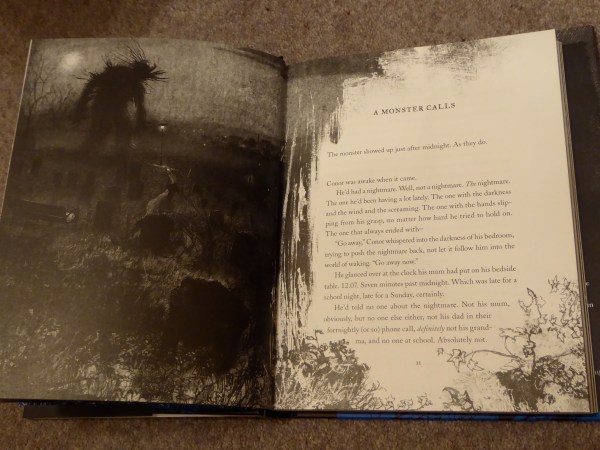
A MONSTER CALLS
A novel by Patrick Ness
From an original idea by Siobhan Dowd (who died, and so the baton – her idea and thoughts for this story – was passed on).
Endings
JUDY CUMBERBATCH
I’ve always thought that the most difficult part of writing a story is getting the first chapter right. It must draw the reader in, give them enough information but not too much, create a memorable setting, bring the characters alive and give the plot enough impetus to hold the reader’s interest and make sure they continue to the next chapter.
 However over the last couple of weeks I’ve been wrestling with ending a book. I don’t mean finding the perfect end, the twist that will make sense of the rest of the book or the right way to resolve the story. No, I mean ending the writing process, taking my hands off the keys and telling myself that I have finished this particular piece of writing; it is time to move on to something else.
I find it a very difficult thing to do.
I have been made particularily aware of this on my most recent project, as it has been a collaboration. The person, I have been working with, comes from a very different background, with a much more pragmatic approach to writing.
So when is a story finished?
I suppose, in my head, I have the notion of the perfect, a piece of writing so polished, that it cannot be improved upon in any way at all. I tell myself that this is what I am working towards, as I edit and re-edit, write and rewrite, change, punctuate, delete, copy and paste over and over again,
At the same time, I also tell myself that every deletion and rewrite is an additional guarantee that the story will not only be accepted by a publisher but go on to win the Carnegie Book Award and be picked up Disney and turned into a multi-million pound franchise. To ensure, a bidding war among publishers, all I have to do is rewrite a particular phrase or sentence, even if the rewording is merely changing an ‘and’ to a ‘but’. I am therefore loathe to let the work go, in case I have missed that surplus adjective in the fourteenth chapter in my frantic reading and rereading of the text -a suplus adjective that will spoil any chance of getting it published.
Of course, I am deluding myself in all this.
There are other reasons for delaying finishing.
By refusing to accept that a piece of writing is ready to be read by others, I am postponing any critical reaction or rejection. Every re-edit is a precious moment gained, in which I can avoid sending the story off to my agent and getting a negative response.
The writing process is full of hope. At the start, you hope the story will come alive sufficiently for you to stay with it. As you continue writing, you hope it will be enjoyed. At the finish, you hope it will be published, be reviewed and be a success.
But once you have packaged a story and sent it off, reality sets in. You can still hope but there is nothing more you can do. Except accept the probable rejection when it comes as sanguinely as possible.
Avo-cado surprise!
MARION ROSE
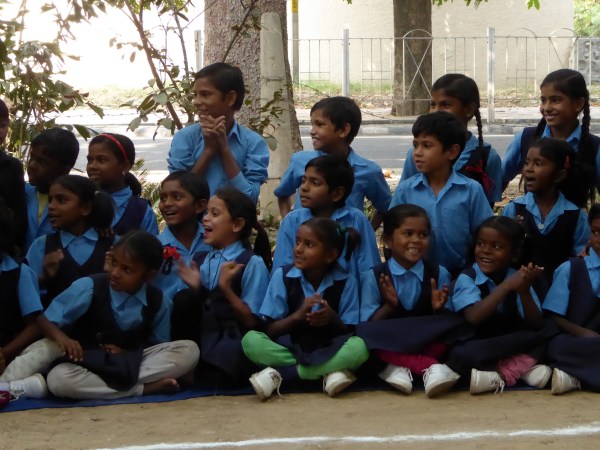
I’ve just been on my longest school visit ever, although it wasn’t a visit in the usual sense. This trip was to a small primary school in Mohali, northern India. I went there as a trustee of the UK charity that helped found it. If I was going to fundraise and advocate on its behalf, I wanted to understand more about Bright Sparks School. While I was there, I also did some sessions with the kids, using my own and other people’s books.
The children live in a shanty town called Mohali Colony. Their parents are mostly labourers or roadside fruit & veg sellers. The kids come to school in their (donated) blue uniforms, from ramshackle homes built on rough ground beside a sewage-tainted river. Their only clean water comes from standpipes in the street. Mostly, each family lives in one room.


The children speak a mixture of home languages: Punjabi, Hindi, other state languages, and English – this being the language they speak least confidently. I had taken some bi-lingual picture books with me, and they were even more useful than I imagined. One of them was ‘Handa’s Surprise’ by Eileen Browne (once a member of this writers’ group!) with dual texts in English/Punjabi, and English/Hindi. It’s a story of an African girl who sets out with seven fruits as a gift for her friend. On the way, various rascally animals steal the different fruits…
I read this book with all five classes in turn. With the younger ones, the teacher read the Punjabi or Hindi page first, and then I read the English. In the older classes, the children read the Indian languages and then learnt to read aloud the English with increasing confidence. All the classes enjoyed recalling the words for the eight animals and eight fruits featured in the story. Surreal scenes in my life now include the memory of standing in a room full of Punjabi kids, all chanting avo-caDO! avo-caDO! – this being a fruit and vocabulary item previously unknown to them all.


Before leaving, I offered to hold a whole-school session using this story. The older kids would do the readings in Hindi and Punjabi, and after, they would all sample and vote for their favourite fruit. The day before, I went to a wholesale fruit market in search of the now much anticipated avo-cados. Sadly, none were available. But later in the evening, my host family kindly took me across Chandigarh to a specialist shop where we could buy some. We also bought some other unusual vegetables to take home with us, like rocket and pak choi.
But, when I arrived at school the following day laden down with all the fruits, I found to my horror that the avocados were not there. Like Handa in the story, I had somehow lost them along the way. To everyone’s polite dismay, we had to use the ubiquitous kiwi fruit as a stand in!
 While the staff were cutting up the fruit in the school kitchen, one of the younger boys appeared amongst us. Without being asked he just set about peeling and preparing the pineapple for everyone. His parents, of course, were fruit sellers. There were many times during my stay when I was struck by the sheer competence and can-do approach of these children. I saw older boys – again unprompted – helping younger children with their unfamiliar shoe-laces on sports day. The classrooms were often cleared of their wooden folding furniture, quickly and safely, by the kids themselves. On visits to their homes, I found them cooking family meals, doing the family wash by hand, sewing and cleaning and looking after siblings, all while their parents worked.
Of course, these are not necessarily the activities I think the children should be doing. Quite the reverse. One of the reasons for the very existence of Bright Sparks School is to give these kids a space in their lives where they can be children, learning and playing, and leaving those adult responsibilities aside. But, I was still impressed by the way in which kids from such precarious backgrounds shared the limited resources and cramped spaces in this little school, and supported each other with great good humour and only the occasional spat.
The avocados did turn up. I’d left them behind at the shop(!). They were sampled by everyone the day after I left. But apparently the favourite fruit was still the one voted for on the day of the readings and the fruit feast. And the winner was… mango. A fruit and a word with its origins in the nearby Himalayas. So no-one had any problem saying that!
https://www.justgiving.com/fundraising/Marion-Rose2
Literature, representation and disability
KATHARINE QUARMBY
I recently delivered a speech at Nottingham Festival of Literature on this interesting subject – how disabled people are represented in literature. The speech is in four parts, and I’ve also embedded links to the speech, which I then recorded later, on my Soundcloud account, where you can have a listen here by clicking on the Soundcloud link.
A quick run-down here:
First of all, I looked at representation of disabled people in classical times. I then moved on to look at representation in medieval times and up until today (yes, a whistlestop tour!) I also looked at the theories of representation, before moving on to where we are now. I examined identity politics, about which I have some reservations, and I looked at the current theme of cultural appropriation, and how it links to disability representation. I want to see disabled writers venture forth from the haven of the first person account, and write more sci-fi, historical fiction, thrillers and so on, not just criticise what non-disabled writers have to say. As the writer, James Baldwin says: ‘My position, though, is that I will not tell another writer what to write. If you don’t like their alternative, write yours.’ Read his full interview, here, in the Paris Review, it’s a wide-ranging and thought-provoking read, and I agree with much of what he says.
My speech is available below as a transcript as well. In it, I draw on research I conducted on literature, art and representation for my first book, Scapegoat: why we are failing disabled people. It’s still in print if you want to buy it.
Spooky Ride
JOHN O’LEARY
Happy Hallloween! Here’s a video of Spooky Ride, my first ever pop-up book, published by Tango Books way back in 2001. Spooky ride was the start of a long and fruitful relationship with Tango Books that still continues. The paper engineer for the project was the very patient Matt Johnstone whom I bombarded with questions at the time. It wasn’t until pop-up book 2 that I took on that role myself, picking it up as I went along.
I’d see n a funfair ghost train in Finsbury Park and wondered how that could translate into 3D book. The final book has one continuous train track running through holes in the pages, out the back of the book, round to the front and back in again – so you can read it over and over and over and over… My brief was to base the illustration style a little on ‘Funnybones’, keep the colours pure and make it scary! – well, sort of, it’s a children’s book.

The Infinite Quest For a Signature Style
SELINA MOORE
The question on how to develop my own illustration style has never previously been an issue I’ve needed to consider. Working in the animation industry I’ve always enjoyed matching appropriate styles to each brief, in much the same way that when writing I would specifically choose individual voices for different stories – in each case there is to me a correct and natural ‘fit’ that will breathe life into the project. I love working this way, working methodically through the reason and motivation for a thing, I feel as though I’m unravelling a strange organic puzzle.
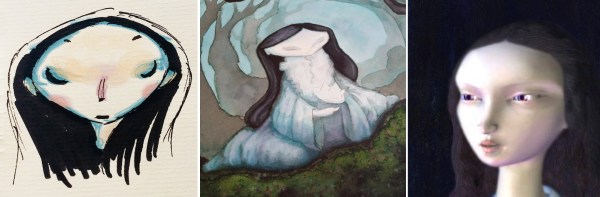
I love to play with different illustration styles. Here are three different interpretations of a character.
So making the move into illustration for children’s books presents an entirely different and unforeseen problem – this is an area where a signature style is usually considered beneficial – as the calling card by which illustrators are recognised and as the reason why people will buy their artwork. And working this way goes against all of my natural instincts.
There’s also a sense of pressure when I try to commit to a single style –its a creativity killer. Searching the Internet for solutions I found the regular mantras:
“Stop worrying about creating a personal style. It will come once you stop looking for it”.
“Follow what your hand wants to draw”.
But after working in the animation industry I’ve accumulated a variety of art knowledge, theory and experience and my aesthetic tastes vary. Do I really still want to draw only what my hand wants to draw? The concept of ‘style’ throws up so many questions -and I found discussion on the subject vague and confusing. Finally, I realised what the problem was. I couldn’t find a solution until I answered the obvious question:- What is ‘Style’?
I discovered a really thoughtful breakdown of style by Sycra Yasin. He considers that artists really mean two separate things when discussing style – ‘Inherent Style’, – derived from our innate way of doing things and our influences – and ‘Manufactured Style’ – a style arrived at through trial and error, iteration and deliberate choice making. Yasin suggests that all artists exist somewhere on this style spectrum and then opens up the debate into issues of stylisation Vs realism and how we arrive at those choices. I recommend this as an incredibly useful watch for anyone interested in parsing the artistic process.
As for me, breaking down the process helped resolve my dilemma. I’m limiting my range to include a few, complimentary styles. I’m aiming for cohesion while still allowing the room I need for experimentation. And most importantly, I’m going to stop worrying about it now!
Our Public Libraries Need Help
ELIZABETH HAWKSLEY
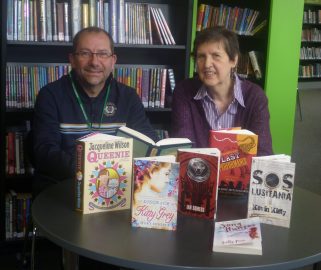
Tony Brown and Elizabeth Hawksley with some of the donated books
I am a huge fan of public libraries; I’ve had a library card since I was six. Nowadays, they offer you far more than just books. With my library card, for example, I can access the Oxford Dictionary of National Biography (the DNB) or read The Times or The Guardian online, and much more. And libraries are currently suffering from ferocious budget cuts.
So, when I became the UK Children’s/Young Adult Book Review Editor for the quarterly Historical Novel Society Review, I decided to offer the ex-review copies to my local library. Every few months, when my floor round my desk has once more disappeared under books, I email Tony Brown, the Stock and Reader Development Manager of Islington Borough library, label the email: Books looking for a good home, and send him a book list. Would he like any of them? So far, he has always said, ‘Yes, please,’ to the lot.
I always get far more books than I, or my wonderful stable of reviewers, can review; often because they are not actually historical (a dragon on the cover, for example, is a giveaway; or the recent book where Lady Jane Grey’s husband has become a horse; or a book featuring jokey zebra gladiators) or where I’ve been sent two or more copies of the same book. So Tony gets an eclectic mix.
Here are six examples of recently reviewed Historicals which I hope other readers will now be able to enjoy in my new list of books for Tony.
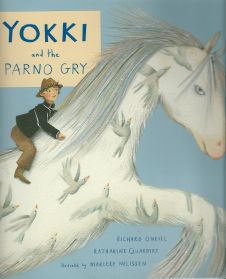


Yokki and the Parno Gry by Richard O’Neill and Katharine Quarmby
Illustrated by Marieke Nelissen
Yokki and the Parno Gry by Richard O’Neill and Katharine Quarmby is a traditional Travellers’ tale with delightful pictures of their everyday lives. It is about the power of the imagination to help in times of hardship and it’s aimed at children of four plus.
And I Darken by Kiersten White
And I Darken by Kiersten White, the author turns Vlad the Impaler, the 15th century Transylvanian warlord, into a girl, Lada. Lada must fight to succeed her father and ruthlessness is the key to her survival. As the reviewer wrote: This is not a book for the squeamish. For girls, age fifteen plus.
Nancy Parker’s Diary of Detection by Julia Lee
Nancy Parker’s Diary of Detection by Julia Lee is a murder mystery set in the 1920s and our heroine is a housemaid who can’t spell. I thoroughly enjoyed this lively story – and the amount of work poor Nancy has to do is 100% accurate for the period. For girls of ten plus.


Rugby Player by Gerard Siggins
Gerard Siggins is a well-respected Irish writer follows the adventures of the 21st century young rugby player, Eoin Madden, with a gift of seeing ghosts from Irish history. Rugby Flyer features real life Prince Alexander Obolensky who became an Irish football legend in the 1930s. A great read and boys of ten plus will love it.
These Shallow Graves by Jennifer Donnelly
These Shallow Graves is set in New York in 1890, where young socialite, Jo Montfort, uncovers the truth about her father’s untimely death. The reviewer praised this book for depicting a realistic late 19th century New York, with a believable heroine struggling with the restrictions on a well-brought-up young lady’s behaviour. This is a young adult novel but my guess is that it will be a crossover book.
Hell and High Water by Tanya Landman
The publisher’s publicity department actually sent me three copies of Tanya Landman’s Hell and High Water! And I can understand their enthusiasm. It concerns a mixed-race boy in 18th century England, struggling to find his place in the world. Landman doesn’t pull her punches about the ignorance, corruption and bigotry of the time. Aimed at both sexes, age twelve plus.
What I enjoy about the Historical Novel Society is that I can keep up with what’s out there and what publishers are looking for. Children’s/YA novels are changing all the time; boundaries are being pushed; and difficult subjects, like race, are tackled openly which would previously have been mentioned more obliquely. Modern children’s Historicals can be challenging as well as terrific reads.
There is a real variety of books for Tony to choose from.
True Life Stories about Mixed Race Britain
ODETTE ELLIOTT
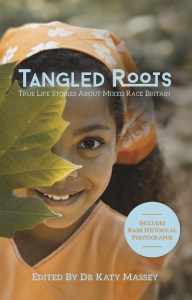 Most of the time I make up stories and concentrate on fiction. However, for about two years I worked on a Memoir about our younger adopted son, who joined the family when he was nearly four years old. The whole Memoir has not seen the light of day. In other words, I have not found a publisher, but I was happy to have a short extract published in an anthology edited by Dr. Kate Massey.
“Tangled Roots – True Life Stories About Mixed Race Britain”.
My true-life story is one of at least twenty five varied and moving stories. It is entitled ‘A Rock for Jah’. It tells about the first time we saw Jah. He was with a short-term foster family, where he had been staying for eighteen months, which was far longer than planned. The family was wonderful and they had been preparing him to move on to a ‘forever family’, but it must have been difficult for a little child, not quite yet four years old, to understand why he had to move onto an entirely different family again.
The reason why I called my story “A Rock for Jah” is because the first time he saw my husband and myself, we showed him a photo of our other three children. It was a holiday snap of them sitting on a big rock in Scotland. Jah examined the photo solemnly and he then pointed out something nobody else had observed – a little rock next to the big one. “There’s a Rock for Jah” he said. It was moving to witness how deeply he wanted to belong somewhere. He had spotted this tiny rock where he could ‘belong’.
Jah’s birth family was partly African, partly from the West Indies and partly white British, so clearly his story belongs in a collection dedicated to multicultural Britain. However, we had already adopted a son from a Caribbean background and we were already a mixed race family before Jah joined us.
The back cover of the book, states “12% of UK Households are mixed race, although experts estimate the actual number of mixed race people may be more than two million – double official figures..”
The collection is described as “a shockingly honest, funny and heart-breaking collection of memoirs revealing the human dramas behind the phenomenal success of ‘mixed Britannia’.”
You can find out more about Tangled Roots on the website www.tangledroots.eu.
Once I realised that I was not going to get my Memoir published, I started writing a blog – Adoption Reflections. It is a very interesting way to communicate to others around the world. More about this in my next Buzz About Books blog post.

