This year, the Historical Novel Society conference is on Sunday, 17th October, 2010 at the Mechanics’ Institute in Manchester.
I shall be doing a workshop on The First Chapter – hooking the readers, which should be fun. I’ve done workshops at previous conferences and always enjoyed them.
I shall also have the opportunity to hear children’s author, Ann Turnbull, speak on Love and Conflict in the 17th Century: Young Adult Historical Fiction. Ann is a writer I much admire. Her most recent book is Alice in Love and War, set during the English Civil War. It is a gripping tale, told with intelligence and honesty and she doesn’t pull her punches about how vulnerable women were at that period. She is also excellent at understanding the adolescent mind and we follow Alice’s progress from naïve young girl, through the bitterness of betrayal by her lover, grief at the death of friends, to a more mature understanding of herself and others.
I’m looking forward to hearing what Ann Turnbull has to say.
To answer, or not to answer: that is the question?
I recently filled out an author questionnaire (with photo) on the authorhotline.com website and, I have to say, I struggled over some of the questions.
Not being as well-known as some children’s writers like, say, Katie Price (aka Jordan), Ricky Gervais, Sarah Ferguson or Geri Halliwell, I wondered whether people would really be interested in my favourite food or most embarrassing moment.
I thought I might try the jokey approach but worried it would look like I wasn’t taking the job seriously. In the end, I aimed for the middle ground, after which I asked my other half for her verdict on the finished answers.
“It’s a bit melancholic,” she told me. “Verging on the tragic even.”
Maybe she means I’m a miserable old git. I’ll let you be the judge – you can find the questionnaire in full here.
While you’re at it, dig the dirt on others in our group – Alison, Anne, Katharine, Marion, and Odette.
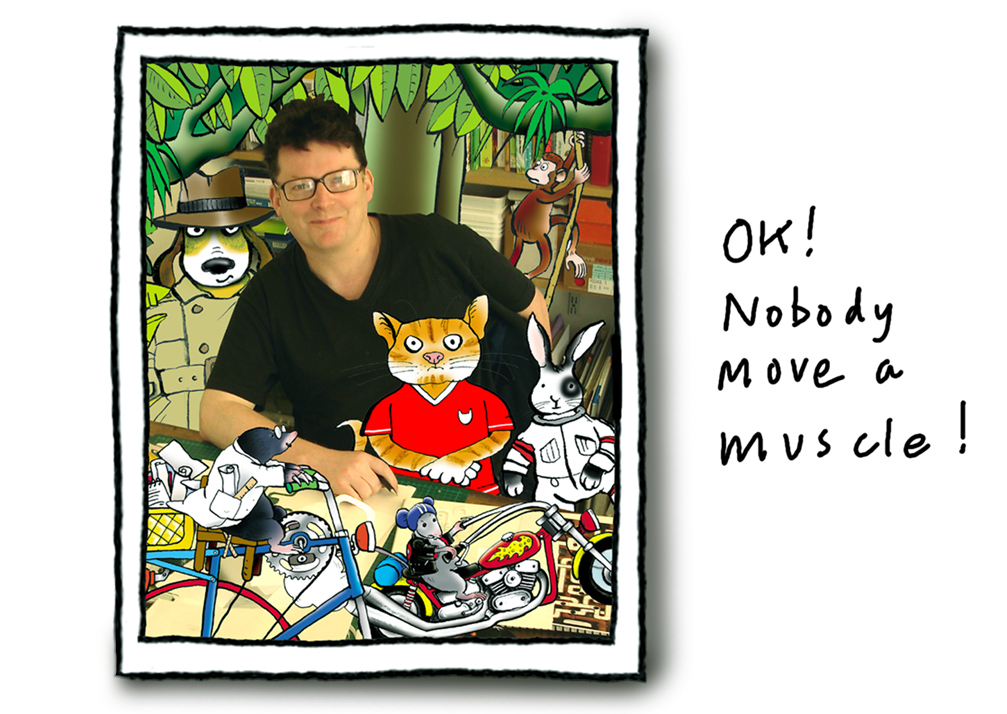
On balancing out characters by Katharine Quarmby
At our last meeting the group commented very usefully on my latest story in progress, Rainbow, about a child of the same name with a very alternative mum. Rainbow decides to do battle with colours in the name of the beauty of black and white.
But my agent had felt that while the mum came over strongly, the little girl was less strong a character – and children’s stories, these days at least, are always led by a child. So it was back to the drawing board – to find ways to get the balance right between the two main characters.
The group came up with some really good ideas of how to do this – and I think that’s one of the strengths of writers supporting each other. Something I’ve written gets extended by others – and then I can get back to writing it. So it can be part of the creative process, not to shut oneself up on a garret!
So now I’m writing furiously, hoping to have another draft ready for tomorrow evening, as well as do my journalism – another balancing act, which I’ll write about on another occasion.
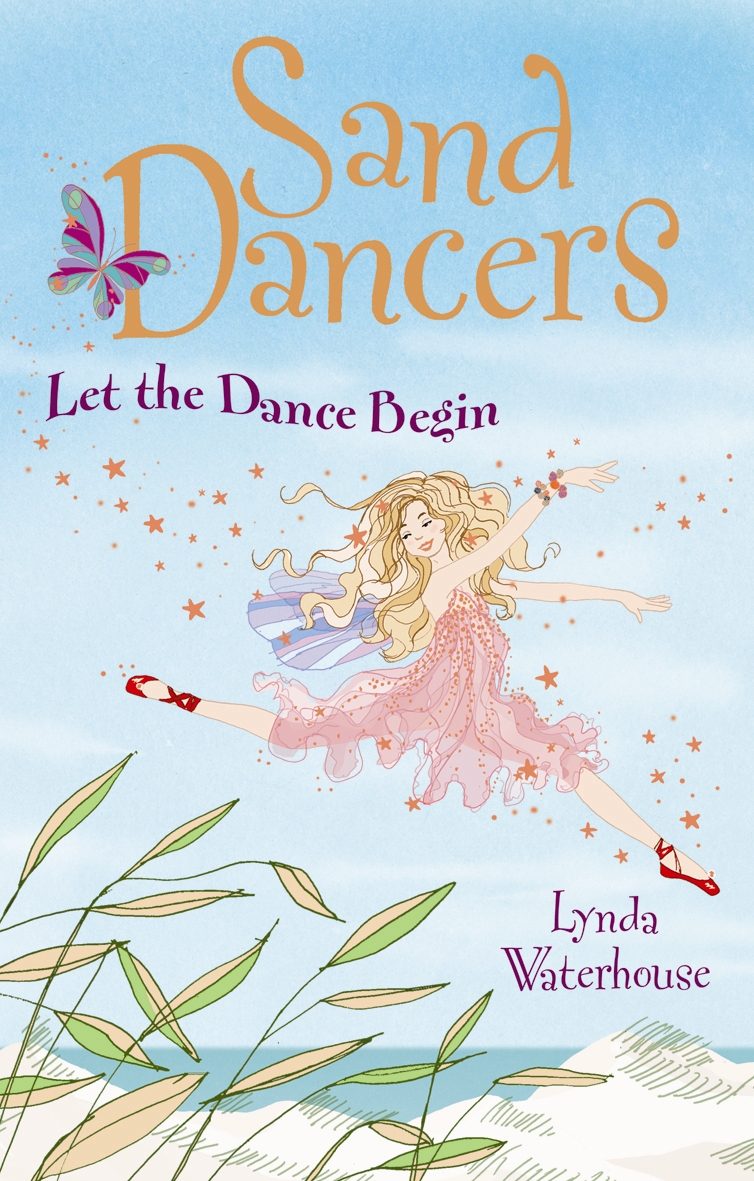
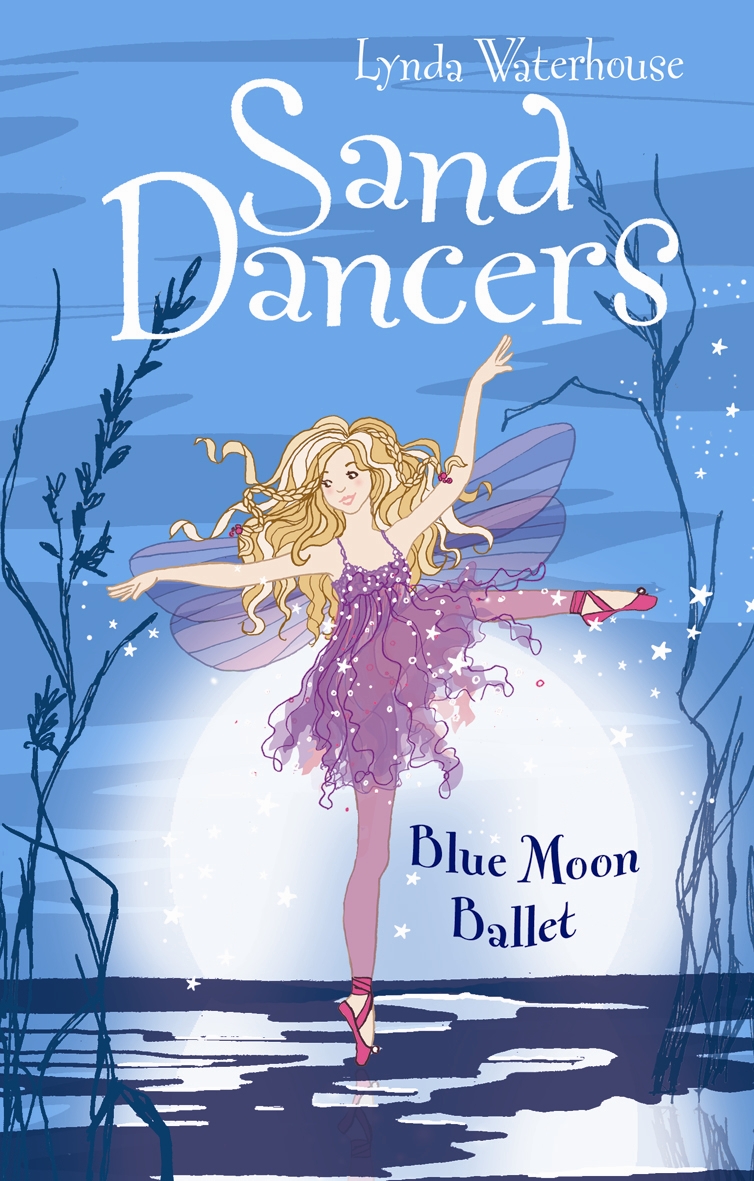
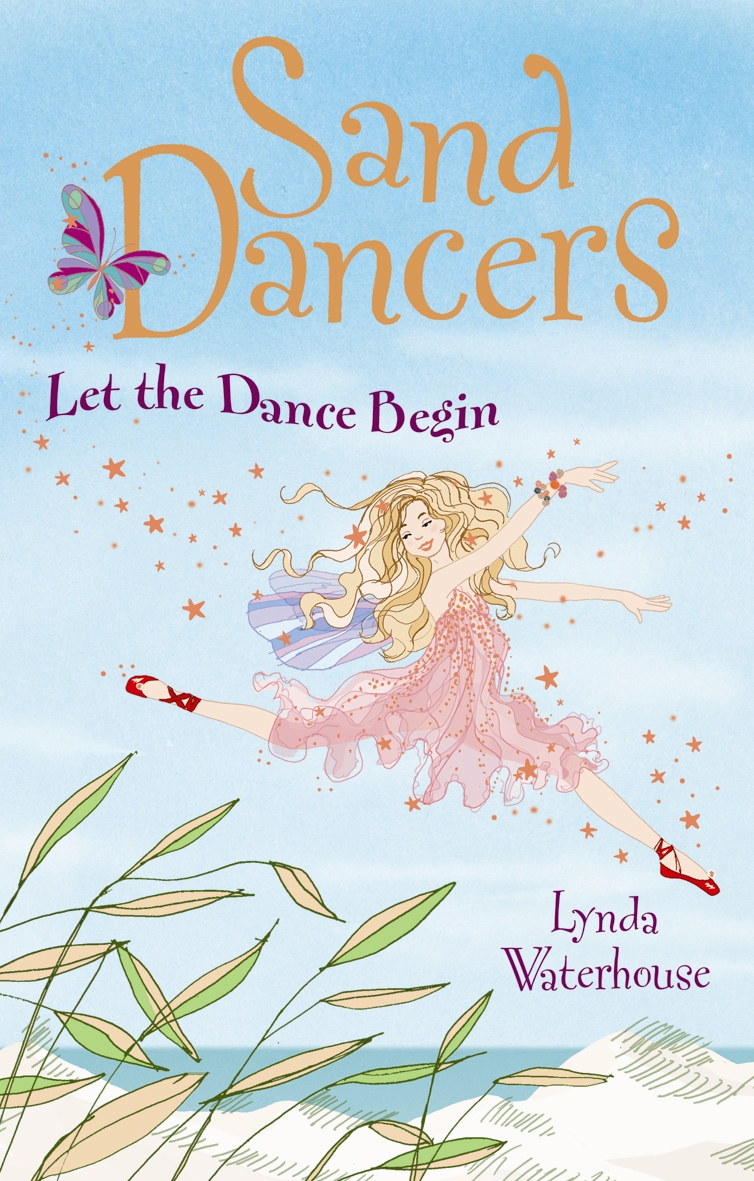
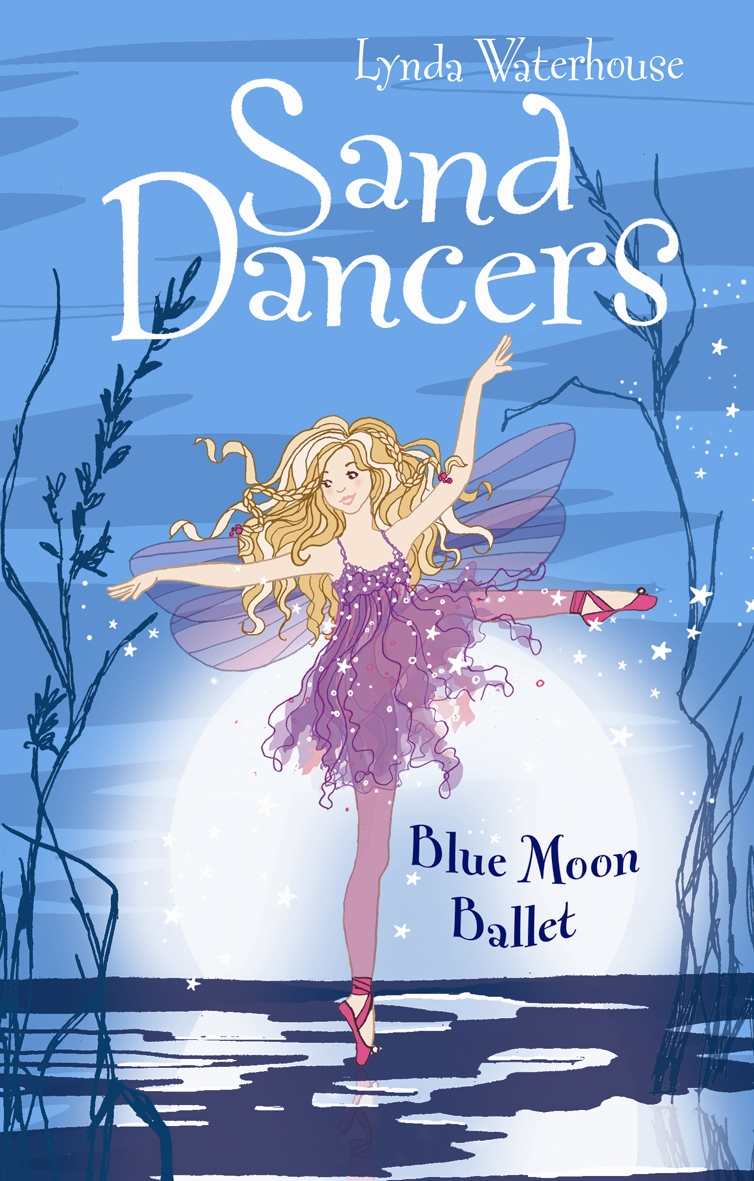
Blue Moon Ballet by Lynda Waterhouse
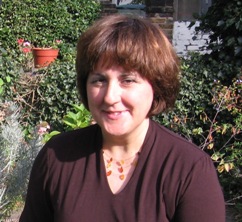 Dance into Words
After many years of teaching I am still in awe of the mysterious alchemy that takes place when a child turns the key and unlocks the world of literacy. Despite what politicians may say it is not just about decoding words, or knowing your sounds, looking at pictures or being able to copy a sentence. These things doth not a reader and lifelong lover of literature make. They are important but a child has to make an unquantifiable and imaginative plunge into this realm. They have to ‘get’ reading and experience the magic it can bring. When the imagination begins to dance then words leap off the page. Witnessing these moments are one of the delights of teaching and the main reason why I write stories for children.
I have always been fascinated by dancers and the way that they have trained their bodies to perform sequences of dance steps. This ‘body memory’ comes from hours of practice and constant repetition of moves alongside a powerful poetic need to express oneself. Dancers tell stories with their bodies.
As a writer it is often when I am walking or moving, usually at a fast pace, that the story in my head takes shape. This sparky duet between my imagination and my body is essential to my creative process.
Blue Moon Ballet is my latest story. It is the second book that is set in the mysterious world of the sand sprites and is published by Piccadilly Press.
William, age 5, reviews two books
I have just sent off reviews of two of Mary Pope Osborne’s Magic Tree House books, illustrated by Philippe Masson and published by Red Fox, to the Historical Novel Society.
I try to find a child of a suitable age to review as well and have recruited William, age five. His mother said in her email: These are William’s thoughts; I have ordered them slightly and added a smidgeon of grammar, but that is all.
Here is a sneak preview of his review of Voyage of the Vikings, set in 1st century AD Ireland:
I read the story with Mummy. I read a bit, and then she read a bit. There are lots of words that were exciting to read like ‘sea serpent’ and ‘jewels’. Brother Patrick was friendly and the monastery was not like anywhere I had been. The Vikings were a bit scary. Mummy thinks that they would be less frightening if you got to know them, but I am still glad that Jack and Annie got away.
When we finished the book, I asked if we could go to Ireland to see where Brother Patrick came from. I wanted to know what happened to the monks after the Vikings landed. Did they escape? I hope there are still sea serpents in Ireland.
He had this to say on Olympic Challenge, set in the 4th century BC in Ancient Greece:
The chariot racing was fantastic and I liked the bit when the winged horse from the lost story (Pegasus) came and rescued Jack and Annie. The pictures in the book were good and helped me imagine what it would have been like in ancient Greece; they dressed in long robes and some of the people wore armour for the Olympic Games.
I didn’t like it that girls couldn’t play in the Games because my friend Nieve is a girl and she is a very speedy runner, much faster than me.
What I found interesting was William’s concerns. His experience is, naturally, limited, and he notes things that are new to him – the Celtic monastery, for example, and the clothes the Ancient Greek men wore. He’s understood that different times have different customs – such as girls not taking part in the Olympic games – and is able to empathize with his little friend Nieve, who would not have been able to take part because of her sex.
As a writer myself, I’m pleased to note that he enjoys words such as ‘sea serpent’ and ‘jewels’. His mother reports that he’s now very keen to go to Ireland and see a Celtic monastery for himself – and is especially eager to see a sea serpent. Plainly, William’s imagination is in excellent working order!
Three cheers to Mary Pope Osborne and her splendid illustrator, Philippe Masson, for so successfully stimulating a small boy’s interest and imagination.
Elizabeth Hawksley
Dame Trot and her Comical Cats (1850)
Last year, I bought an old copy of ‘Dame Trot and her Comical Cats’ and I’ve been doing some research into it.
Books specifically aimed at children first appeared in the 18th century. They were only the size of playing cards and had crude wood cuts. Then, in 1805, an enterprising printer, John Harris, published he‘The Comic Adventures of Old Mother Hubbard and her Dog’, a 4 x 5 inches book with eighteen hand-coloured copperplate engravings. It sold ten thousand copies in a few months and made his fortune. Harris went on to publish many other traditional rhymes in the same format.
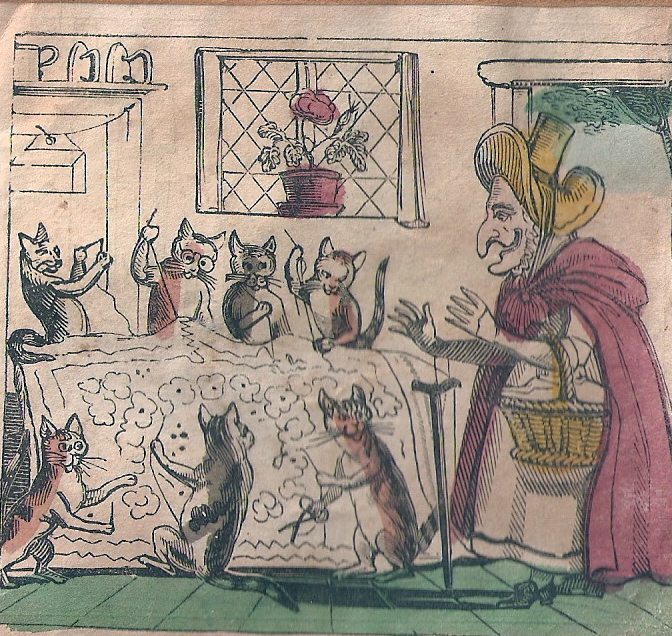
Cats hemming handkercheif
What interested me was the hand-colouring: ten thousand books with eighteen pictures in each is an awful lot of hand colouring. And they were all done by children. It was a cottage industry; the children sat at a table, each painting a different colour: red, blue, green, yellow and brown. My own 19th century copy is also hand-coloured – you can see occasional splodges where the colour went outside the line.
Then, in 1813, a rival publishers, Dean and Munday, brought out ‘Dame Wiggins of Lee and her Wonderful Cats’, sub-titled, ‘a humorous tale written principally by a lady of ninety’. It is an enjoyable read, even today. The cats do various comical and useful things: go skating, mend the carpet, ride sheep and so on. Dame Wiggins has an angular profile like Punch’s wife, Judy.
So where does Dame Trot come in? The story is first mentioned in 1706 and has many similarities to Mother Hubbard, except that Dame Trot has a cat rather than a dog. In 1820, Harris brought out his own version of ‘Dame Trot and her Cat’. His Dame Trot is a round, cosy old lady, very unlike Dame Wiggins. It, too, was a success.
By 1850, John Harris was dead and Dean and Munday wanted to cash in on the success of Dame Trot but they didn’t have Harris’s copperplate engravings. So, instead, they used their own Dame Wiggins of Lee engravings, changed Dame Wiggins’ name to Dame Trot, gave her six more cats, and adapted the text to suit. For example, in the original, Dame Wiggins’ seven cats mend a carpet, but Dame Trot’s cats mend a large silk handkerchief, and the colouring is different.
It all goes to show that you can’t keep a good story down.
Elizabeth Hawksley
Memories of books I have loved. – Odette Elliott
Recently I read someone’s blog about a book that she loved as a child. She said that she has never heard it mentioned anywhere, but she loves it.
This interests me, as one of the great things about having a book published is that one never knows who might read it. Or who will love it. A book could be distributed anywhere from the Outer Hebrides in the North, to South Island, New Zealand in the far South. Somebody could pick the book up and read it in a library shortly after it was published. Or it could be discovered decades after publication, for example in a grandparent’s house.
Admittedly some books do not stand the test of time. I remember being really sorry for my father, when I saw some of the books he had as a child. He was born in 1908. They were along the lines of “Good Dan” and “Bad Billy” and seemed very much like boring moralistic messages. On the other hand, some of his boys’ adventure books were decidedly better.
Here are two books that I loved as a child. So far I have never met anyone who has read either, but it is quite possible that they had a large, devoted readership.
The first is “Jam Tomorrow” by Monica Redlich. It was also published in Puffin, so it was probably popular. It mentioned American cousins who came to live with an impoverished vicar’s family. One of the cousins was a sophisticated American teenager and it took a while for all the cousins to settle down together. It also mentioned finding treasure in the large old rectory. I suppose it satisfied the emerging teenager in me, as well as the child who liked adventure and surprise.
The second book is “Shadow on a King” by Frank Cox. It was set in the reign of King Charles 1 of England. The action passed backwards and forwards between France and England. It was very fast moving and exciting. I know that I read and re-read it many times.
My point is that there are some books “out there” that might not be very famous or make much money, but bring great joy to someone somewhere.
Great news for library lovers! Free internet, coffee shops, Sunday and late opening hours are just some of the ideas planned for our public libraries. According to a recent report by accountants KPMG, poor literacy costs the economy over £2.5bn. It’s no surprise then that just weeks before the election, Margarent Hodge, Minister for Culture released the policy statement, the modernisation review of public libraries, listing some of these obvious but really rather great initiatives to get us all reading and contributing to the economy.
Libraries are free, 34 million people visit them every year and on average, libraries cost just 5p per person per day to run. In her introduction to the review Ms Hodge says: “With more branches than McDonalds or Boots, and more visits to libraries than shoppers in London’s West End, the public library network is a triumph of infrastructure and branding.”
The Society of Chief Librarians (SCL) also published its manifesto last week, outlining the core ways that libraries help local people and calling for continued investment in this critical resource. The manifesto clearly states that libraries are adapting to and meeting the needs of local people, and every library in the UK is focused on core principles of reading, learning, literacy, and digital inclusion.
The BBC also picked up on the news commenting that ‘the proposed changes come after figures showed visits to libraries fell in 2008/9 and adult book issues were significantly down.’ It also quotes the Chartered Institute of Public Finance and Accountancy that says; ‘while loans of adults’ books in England have steadily declined in the past decade, children’s book issues have been increasing year on year for the past five years.’
When you think about it, it is amazing how libraries have survived and been so prolific considering how little they’ve adapted to the constantly changing digital universe. I would like to think that a lot of the credit for a continued rise in children’s issues is due to author visits, and the power of face-to-face storytelling in both libraries and schools. To ensure this continued growth, it is clear that we authors not only need to keep writing the stories that keep children reading, but also think about the way we tell them off the page and on the screen. And according to these pre-election promises, it looks like libraries may, possibly, perhaps, finally be on their way to facilitate more of this in more interesting and relevant ways.
Between the age of eight and ten, I read this book dozens of times – and I’ve been trying to analyse its appeal. The children’s author, Rosemary Sutcliff, who loved it too, wrote: By no means every child will like Kipling … But every child should have a chance to discover whether he does or not. Because he who has never run with Mowgli’s wolf pack has missed something that he will not get from any other source.
So what is it? It’s partly to do with the language (it certainly influenced Rosemary Sutcliff’s writing). The register is deliberately old-fashioned (plenty of thee’s and thou’s) and formal: Look well, O Wolves! I liked the poetry of that. It gave the story a sort of gravitas and emphasized that this was a very different world from chilly north-east England where I lived.
It’s also very sensuous. You can taste the wild honey, feel the silkiness of Bagheera’s fur, see Cold Lairs, the abandoned city in the jungle where ‘the shattered domes of temples had wild figs sprouting on their sides’.
In the story, Mowgli, abandoned by his parents, is adopted by the Seeonee wolf-pack where he is loved and accepted and where the rules, the Jungle Law, are clear:
If ye kill before midnight, be silent, and wake not the woods with your bay,
Lest ye frighten the deer from the crops, and the brothers go empty away.
As a child, I thought the Jungle Law was fair and sensible; every animal has a part to play and there is mutual respect – unlike the adult world I knew, which was frequently unfair and incomprehensible.
Many children feel abandoned and unloved – as Kipling himself must have felt when, age six, he was taken from India, where he was born, to a cold, wet England and boarded with strangers who treated him with a cruelty he never forgot. I believe that Mowgli’s story taps into this emotional trauma and provides comfort. Mowgli can get it wrong, as when he takes up with the monkeys and is abducted, but he knows he will be rescued, unlike the young Rudyard, who was left for five long years. Moreover, Mowgli wins through and ends up Master of the Jungle.
I agree with Rosemary Sutcliff: The Jungle Book has something special to offer, particularly to an imaginative child who, for whatever reason, feels unwanted and subject to the arbitrary demands of adults.
 Buzz about Books