Killing off a character Marion Rose
This week I’m in mourning – for a character I’ve come to know, and absolutely love. No, it’s not Jack Duckworth from Coronation Street, though I gather millions are missing him like one of their family. My grief is for a character in the children’s novel I’m reading. A loveable voice that is still in my head – funny, loyal and utterly real.
But as well as sadness I’m feeling a little bit angry. Did this death really have to happen? Is it justified? It’s making me ask what DOES make a ‘good’ death in fiction? There are some deaths I can think of that are completely heart-rending yet also absolutely right for the storyline. Charlotte in ‘Charlotte’s web’ for one. Private Peaceful is another.
In both those cases, the character dies to give life to others. And that is also true of this character. And yet for me, this death does not satisfy. For one thing, it’s left me thinking less of the characters who do survive. But much, much worse, the world of the novel left behind is so much duller, in fact positively impoverished, with this character no longer there. (Writer beware!)
I haven’t mentioned the character’s name in case you have not yet read “The Knife of Never Letting go” by Patrick Ness, the first of a trilogy. This first book tells the story of a boy’s flight from everything he knows. It’s set in a strange and highly original world where men’s thoughts cannot be kept private but are out there as Noise. In all other respects I thought this novel exceptional – brave and fresh and very compelling. Read it, if you haven’t already. My hope is, that the next two novels may cast a redeeming light on this (for me) too-early death.
Meanwhile, I’d be interested to know if anyone else has strong feelings about the killing of a character – be it your own, or someone else’s?
On fiction and non-fiction – KQ
I’m nearly at the end of nine months hard slog on my first non-fiction book for adults. Not a cheery subject either – disability hate crime is grim – as my children keep telling me. They want me to write something cheerful next – and I don’t blame them. But they have read the odd extract, including a poem by a disabled woman, who, as a child, saw a friend of her being drowned by nurses, like an unwanted kitten. And I don’t apologise, either, for sharing it with them – children of their age, who I met when I was filming in Rwanda, had seen torture and genocide. Indeed, when I was translating testimonies for a Rwandan charity after the genocide the one that struck me most was of a woman who had witnessed the Hutu militia strew chilli pepper in the houses of the wanted, so that children, hiding behind furniture and under beds, could be hauled out and murdered. We can’t shield our children from all that, not for ever, not in a networked world where the concept of the watershed has all but gone, but we can teach them how to live with it, understand it and be part of the generation that says: “never again”.
So I’m looking forward to writing something cheerful next, and going out filming again instead of writing this hard, every day. But I’m also wondering how we show children, in our prose, our poetry, our fiction and our non-fiction, a vision of how the world ought to be, as well as how it is. A modern utopia, so that when they read about the everyday harassment of disabled people they can also see a world beyond that, a world where people are taking down walls and ceilings(thank you Judy, for your wonderful thoughts on the walls in our minds) rather than putting them up – shaking hands, rather than striking each other.
Comments please!
My Leeds Experience – RITA MITCHELL
 On the 26th July 2010 I spent a delightful day at Blackgates Primary School in Leeds.
I was the guest of tutti frutti, a production company for young children theatre. The company tour and perform in a variety of venues in Yorkshire and Lincolnshire. I was privileged to see a grand performance of Hue Boy. It was dramatised using the captivating title of UNDER THE PARASOL.
I played my part by contributing a basket of Hue Boy’s favourite , exotic fruits for the children to taste. The play was brought to life by the able acting of Stewart Thomas who intelligently interpreted the essence of the story.
I cannot praise the performance too highly, and was gladdened by the dedication and pleasantness of the production team.

UNDER THE PARASOL – HUE BOY. It’s the best production I have seen for the children’s age – Cleethorpes Library
Elizabeth Hawksley: Children’s author, Ann Turnbull
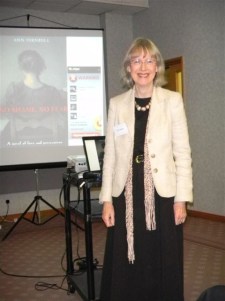
- Ann Turnbull
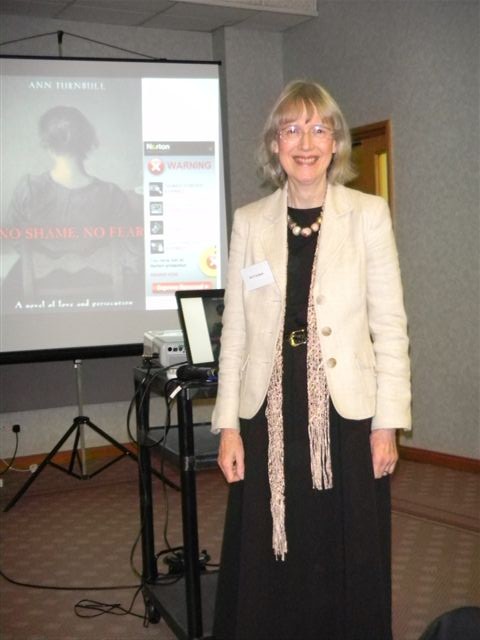
Ann Turnbull’s books have been short-listed for the Whitbread Children’s Book Award and the Guardian Fiction Prize amongst others, and I have long been a fan of her writing. Last weekend, I had the pleasure of hearing her speak at the Historical Novel Society conference in Manchester. She was talking about her three latest books, young adult novels set during the English Civil War, including Alice in Love and War.
She showed us some of the maps and old prints she uses in her research, as well as printed material. The explosion of printing in the Civil War meant that, for the first time, we can hear the voice of the common man. Research is a difficult area for historical novelists; I have read too many books full of glaring ‘information dumps’. Sometimes, I can even tell which history books the author has been reading.
Ann Turnbull’s research, however, is unobtrusively woven into the story with great subtlety. It illuminates both the political and military backgrounds and the mindset of the time. She is interested in how war affects ordinary people, especially women.
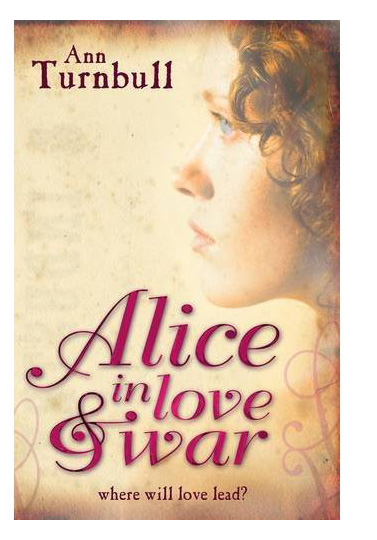 Alice in Love and War opens in 1644; sixteen-year-old Alice is thrilled when handsome Royalist corporal, Robin Hillier, shows an interest in her and she persuades him to take her with him when his regiment leaves. She’s sure he loves her and that they’ll be married one day. It is a terrible mistake ….
Alice soon finds herself in a very vulnerable position. We both admire her for her courage and are deeply concerned for her as she rides through the countryside full of marauding soldiers, happy to plunder, rape and murder, and hostile villagers for whom Alice, a despised woman from the baggage train, is ‘vermin’. Alice has much to learn about men, love, and the brutal realities of war – and Ann Turnbull does not pull her punches.
I am always interested in how other writers work, and I was fascinated to learn that Ann writes in longhand, in pencil, (she finds it more comfortable) and uses small notebooks for a time line and notes on various things she thinks she’ll need.
I was delighted to meet Ann and to have the opportunity of hearing her speak. Her website is: www.annturnbull.com
Elizabeth Hawksley: A Disaster
One of my favourite books as a child was ‘A Child’s Day through the Ages’ by Dorothy Margaret Stuart. One of the stories, set in Athens in 438 BC, tells of the arrival of a baby brother to ten-year-old Ageladas and his little sister, Doricha.
It is a time of rejoicing. Their father hangs a garland of olive above the front door to tell everyone that a son has been born. But, as Ageladas’ tutor adds, ‘There is little joy when a girl is born and they hang up a fillet of wool so that their friends may know that there will be no great merry-making.’
Poor Doricha has a rotten time, ‘Already she had been taught that girls must always give way to boys, as women did to men; already she had been made to understand that her part in life would not be to have fun and do interesting things, but to learn to weave and bake and spin, so that some day she might be a good housewife like her mother.’
However, there is one thing Doricha does which sounded really exciting. And that is play on a see-saw – Greek style: ‘Greek children did not sit on either end of the see-saw; they stood up-right, on their toes, keeping perfect balance and timing their jumps to the second.’
There was a see-saw at my Primary school on the edge of the play-ground, next to a rockery. So I tried see-sawing the Ancient Greek way, standing up. Unfortunately, I didn’t have Doricha’s perfect balance or timing. I fell onto the rockery and ended up in hospital having my head stitched.
‘What on earth were you doing standing up?’ asked my mother, crossly.
How could I possibly explain? I spent much of my childhood living as somebody else in my head, in other times and other places. I’d been there, with Doricha, enjoying her feeling of freedom as she timed her jumps perfectly. I still bear the scar – but perhaps it’s a small price to pay for the gift of imagination.
Images 34
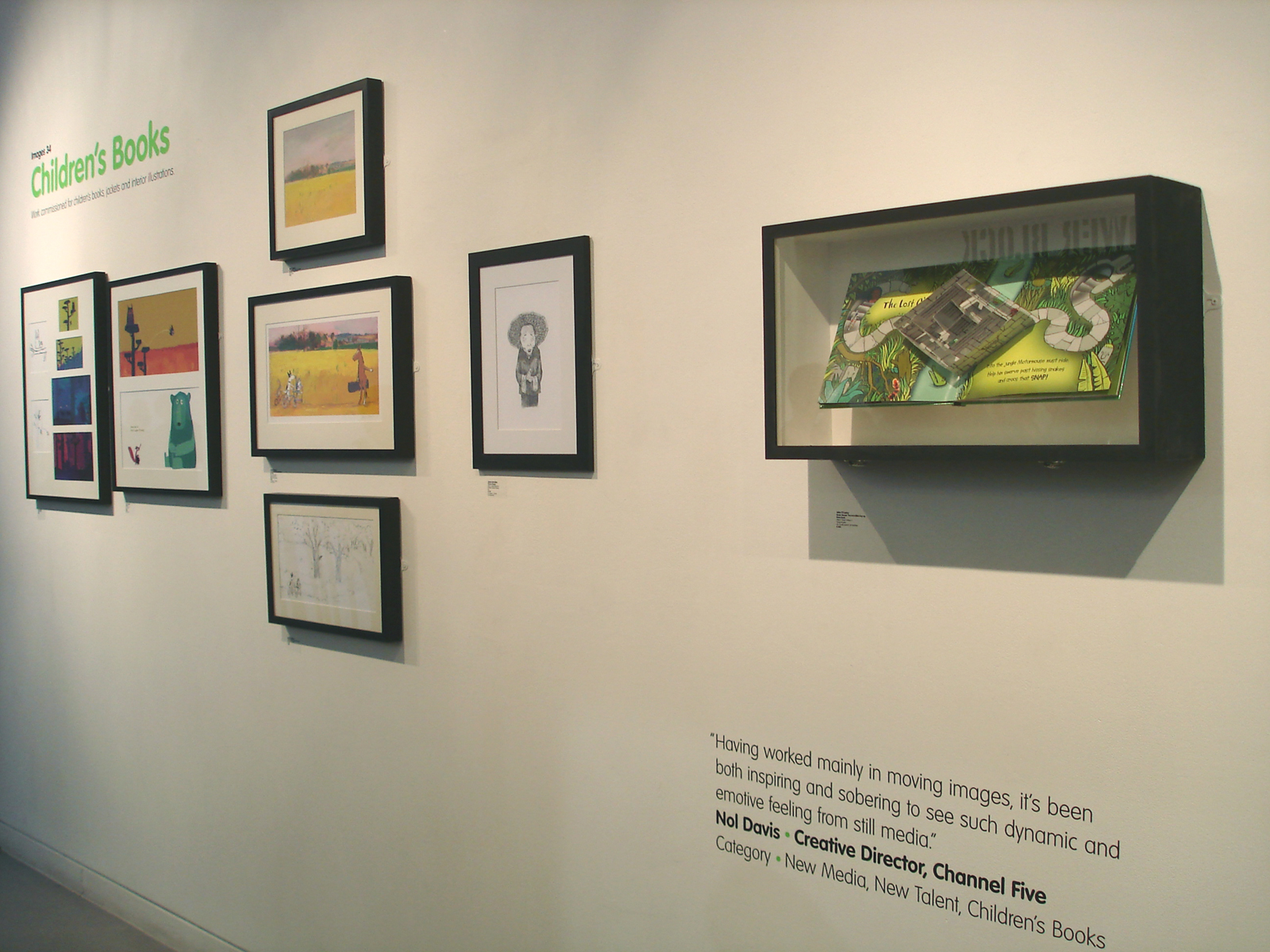
Pop along to Elephant and Castle to see Images 34, organised by the AOI (Association of Illustrators), at the London College of Communication. The exhibition has a special section for work commissioned for children’s books, jackets and interior illustrations.
Images is the UK’s definitive jury-selected illustration competition, annual, awards show, and touring exhibition dedicated to showcasing the very best contemporary illustration published in the UK.
At least that’s what the AOI says, and who am I to disagree – especially as yours truly has two pieces, from It’s Magic and Motor Mouse, featured in the aforementioned Children’s Book section. One of these is also in the exhibition.
Images 34 is open to the public from 8th – 14th September. Entry is free.
JOHN O’LEARY

Elizabeth Hawksley: When I was Eight
When I was eight, I wrote the following poem. It is called ‘Macbeth’.
‘Double, double, toil and trouble,
Fire burn and cauldron bubble.’
This is what the witches sang
Dancing round a great black can.
Suddenly, they turned around
And a strange observer found.
He came to ask for their advice,
For he thought them very nice.
They told him, ‘If you ever should
Look at yon fair Birnam Wood,
‘If it should move, one day soon,
Macduff will slay thee by full moon!’
At school, we were taught that poems had to rhyme and to scan, that is, the rhythms and stresses must be regular. I didn’t know that you could write poetry that didn’t rhyme or scan.
So, I had four rather plodding iambs per line, except for the occasional extra weak stress at the beginning of a line, as in: They told him, ‘If you ever should , which I needed for it to make sense. And it rhymed.
I remember writing it. I struggled to find a rhyme for ‘sang’. Reluctantly, I came up with ‘can’, which I wasn’t happy with. It felt banal – though I didn’t know that word, then. I was also worried about ‘nice’ rhyming with ‘advice’ for the same reason. I really wanted a word which meant ‘scary’ but I couldn’t think of one.
I was proud of the ‘Macduff will slay thee by full moon’ bit, which I thought was both poetic and dramatic (I liked the ‘slay thee’). But the line which really impressed me was ‘And a strange observer found.’
I needed a rhyme for ‘around’ and, in desperation, I showed my poem to my Uncle Freddy and asked for his advice. He suggested, ‘And a strange observer found’. I saw at once that his line was much better; it not only made the line rhyme, it also, somehow, made it more exciting, but it worried me that ‘found’ was in the wrong place.
Uncle Freddy told me that you were allowed to change the word order in poetry. It was a revelation. His explanation taught me something important: that word order can change the emotional colour of what you write. He didn’t laugh at my poem, he took me seriously and he helped me on my way as a writer.
This little piece is my thanks to him.
For your information by Lynda Waterhouse
Multicultural Picture Books – recommended titles
On www.eileenbrowne.com you’ll find an ongoing list of over two hundred recommended books. It’s for teachers, librarians, bookshops, publishers of children’s books, parents, carers, and everyone who is interested in books for children aged 0-11+ years.
Eileen says, ‘This project began years ago, when I realised that by publishing on line, titles could be continually added. Making and managing this website in my ‘spare’ time has been a long and painful process.’
Thank you Eileen for creating this valuable resource
Elizabeth Hawksley: Adèle Geras on ‘Young Love’
I was fortunate enough to hear children’s author Adèle Geras speak earlier this month on ‘Young Love – how to write it and who it is for’.
She began by pointing out that if you aim your love story at teenagers and your main protagonist is, say, fifteen, then your readers will be both young teenagers, roughly the age of your protagonist, and ‘aspiring’ teenagers of about nine plus. And they will be looking for different things.
The younger readers will be reading for information: what happens, how do you do it, and so on. Think readers’ manual. It’s important that you, the author, don’t assume any prior knowledge on their side. Adèle believes that children know about strong emotion from a very early age: love, hate, fear, jealousy, rage etc. Authors don’t have to pull their punches here; children are quite capable of coping.
Teenage readers, on the other hand, will be struggling with the emotional turmoil of young love: the agony of those tentative approaches; feelings of inadequacy; what happens when you fancy someone; how to get out of a situation you don’t want; coping with unrequited love and so on. They won’t be worrying about how a third party in a love triangle feels, say, which is a more adult concern.
She pointed out that teenagers also face problems adults don’t, for example, privacy. So, a writer’s first job is to get rid of any parents. Whether your characters are after an adventure on Dragon’s Island or some sexual experimentation, they certainly don’t want their parents around!
Adèle prefers not to go into the physical details; what interests her is love and conflict, emotional tangles, obstacles in the way. These can vary: parental disapproval, a Romeo and Juliet situation, the eternal triangle, self-inflicted barriers, etc. She reminded us that teenage readers would probably also be reading adult novels. She sees her job as showing that reality in love is very different from the fantasy world of romance. It is more conflicted and messy, for a start.
Finally, she advised us to take the market into account. Publishers like books which could develop into a series, for example. They are also looking for a strong plot and three-dimensional characters. Books can be first or third person but, if first person – and teenagers love the first person – you will have to airbrush the language to remove most of the ‘like’s’ and other teenage stabilisers. Thanks to the J. K. Rowling effect, any length is now acceptable.
Altogether, it was a most interesting and illuminating talk which stimulated a lot of discussion afterwards.
Adèle’s website is www.adelegeras.com
The ancient art of storytelling
THE ANCIENT ART OF STORY-TELLING – Odette Elliott
As a children’s author, I love stories and storytelling.
Right from the beginning our grandson Cameron showed a marked preference for non-fiction books. Whenever his parents took him to the library he would come home with a pile of books that he wanted to share with me, all about the tyre treads of tractors and different vehicles. In fact I have learned quite a lot through his observations. I once pointed out with great delight to an adult friend that we were passing an extremely interesting lorry with a double trailer. She gave me a withering look, but I didn’t care! I have enjoyed learning about such things. Even a hole in the road holds a new interest for me.
I knew that my grandson listened to stories at bedtime, but I found it hard to keep his attention when reading what I thought was a lovely story to him in the daytime. To my chagrin he did not listen to the first story I wrote – “Under Sammy’s Bed” -. However, fortunately he does enjoy “Sammy Goes Flying”. It is seen as exciting. That is good, as it is due to reappear with new illustrations and a pared-down text next year (April 2011).
I wanted to share so many stories with Cameron and at last hit on a strategy. It was simple really. I resorted to telling him the old favourites. I didn’t need a book in my hand. I could do this for example while sitting on a park bench, if he sat down to catch his breath from rushing around. I discovered that there were many good opportunities for storytelling.
The very best moment I had was when I was re-telling the story of The Little Red Hen. He looked so concerned that no animal in the farmyard was willing to help her and he asked anxiously “Can a Boy help?” I said ‘Yes” and he hurried out of the room, acting out bringing in the sugar, then out again and back with the flour. The entrance with the eggs was so adorable as this little three year-old walked very slowly and carefully and delivered into my hands some pretend eggs for the pretend cake.
I was very happy to see that there is something enduring about the joy of storytelling and the sharing of moments of imagination.
 Buzz about Books