Odette Elliott-A couple of thoughts about Libraries for ALL.
I was distressed a while ago, when I heard that the Homework Club in my friend’s local library was being closed. I knew how valuable this had been for the children who attended. There are children with no computers at home and no peace to study.
Clearly the loss of any library will be a major disaster for poorer children, who may not have access to books in their homes. This goes without saying and it is really distressing.
People seem to suggest that in many middle-class homes, people just go ahead and buy books and don’t use the library. But what about the child who is just learning to read, who wants to take out every “Horrid Henry” book? The parents will not want to buy each of those books, as the child will fairly quickly move on to something else. The library provides just what the child needs in his or her early reading days. (The same goes for some series books – for example books about fairies. They serve a purpose for the moment.)
My grandson is surrounded by books in our home, but what he has preferred so far, are books about Diggers, Lorries, Tractors etc. We have been able to borrow all these information books from the library and not only has HE been delighted, but I have learned quite a lot!
And there is the matter of browsing. I know that so many books are available on Amazon. However, how does one know what will catch one’s eye and imagination? Yesterday I saw a fantastic book displayed in my library. It is “Animal Migration – Remarkable journeys by air, land and sea”. It is published by the Natural History Museum, price £14.99. I borrowed it from the library. I can’t wait to sit down and read, enjoy and learn about one of the most mysterious aspects of animal and bird life. I also expect to be able to look at it and share the delight and wonder with my 12 year-old grand-daughter. I only discovered this book while browsing in the library.
Browsing is good. Libraries are excellent – for us ALL!
Am I a bad writer?

Just how bad a writer am I? Asks Vernon Lott to America's top authors in Bad Writing The Movie
From the dark awakening
Cold thoughts of fear hold
Into my cap fall
Tortuous glimpses of dawn
And her many warm epiphanies.
I should make it very clear that I didn’t write this. It is a ‘verse’ from the poetry of Vernon Lott, a writer on a journey to discover why he is not succeeding; a question at the top of my mind following the recent rejection of my manuscript.
Interviewing some of America’s most successful contemporary authors from David Sedaris to Margaret Atwood, Vernon records this journey in the moviementary Bad Writing The Movie. Here they either laugh, scoff, patronise, warmly guide and advise but fundamentally they all agree that his work is terrible.
Not realising that I am suffering the intellectual bruises of another rejection, a lovely friend of mine unwittingly sent me the trailer as you can watch here. One could argue his timing is deplorable but actually I should thank him because he has forced me on a journey myself.
Once past the deep depression that my work is as bad as Vernon’s, past the cringe factor of hearing generally indulgent writing, I was then galled to my guts with the confronting insight from Margaret Atwood who says; ‘There is no rule that says your work steadily gets better.’
Damn. Double Damn. Am I a bad writer? And will I be a bad writer until the end of time?
When I ask myself these questions, as have the members of his facebook group, Vernon’s line above strikes a frighteningly resonant chord. And in that case, by rights perhaps his work is not that bad and maybe, just maybe George Saunders, Margaret Atwood, Miles Corwin, Nick Flynn, Aimee Bender, D.A. Powell, Lee Gutkind, Steve Almond and the agent I am trying to be signed with are also wrong?
Somehow I doubt it, but I will keep writing, badly, until…
Lorna Hoey: Those awkward questions…
With the party invitation comes the situation I most dread. It’s not about the dress, the shoes or the hair. It’s not about how to get there or who’ll be there. It’s worse than all of these things.
It happens when I’m standing at the canapés, or the buffet, or the drinks table or (more than likely) in the kitchen, and somebody sidles up to me and starts one of those conversations which inevitably culminate in: ‘So now that you’re retired, how are you filling your days?’
And here we go. Do I say vaguely, oh, never been busier, can’t think how I found the time to go to work, all that stuff? Or do I come clean? Usually it’s easier to take the first option, but sometimes, if I’m feeling brave – maybe after a prolonged visit to the drinks table – I will say that I am a writer. And why not? It’s what I do, and I do it every day.
But then comes the inevitable response: Really? What have you written? Should I have heard of you? And at this point I have to admit that as I’m not yet a published writer, then it’s unlikely that anyone has heard of me.
Ah, comments my smiling assailant, already veering off to more interesting pastures, it’s just a hobby then. I feel stung, cheapened. It is my dearest wish to be a published author and I work towards that each day. I feel insulted. But should I? Can I really call myself a writer?
Recently, having repeated this scenario – probably once too often – to a friend, I was given a little book entitled You know you’re a writer when…which contains a number of statements apparently designed to test your commitment to the scribing world. Here are a few examples:
You eat dinner with your plate on your knee because your manuscript is laid out on the table.
In bed at night, it’s not your own problems that keep you awake, but those of your characters.
You assess every person you meet as either poor or good character material.
You can work alone in a room for a year.
As you back the car into the lamppost, all you can think about is how to describe the thud of metal on metal.
Every surface in your house has morphed into a desk
Despite anxiety, humiliation and frustration, you can’t stop writing because you are doing exactly what you should be doing.
And it’s that last statement that holds the key. I can’t stop writing and if that makes writing my hobby, so be it. One day somebody will take a chance on my work and I’ll be a real, published author.
But for now I’m happy – no, proud – to call myself a writer. I just need the courage to say so.
Maybe another visit to the drinks table?
Bookstand
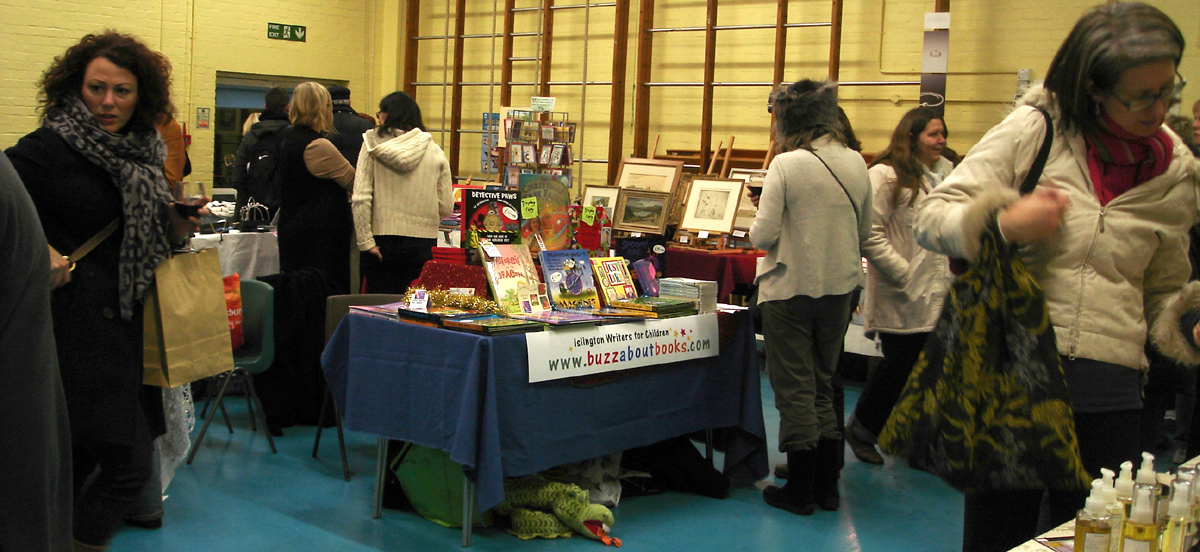

Lynda Waterhouse mans the stand
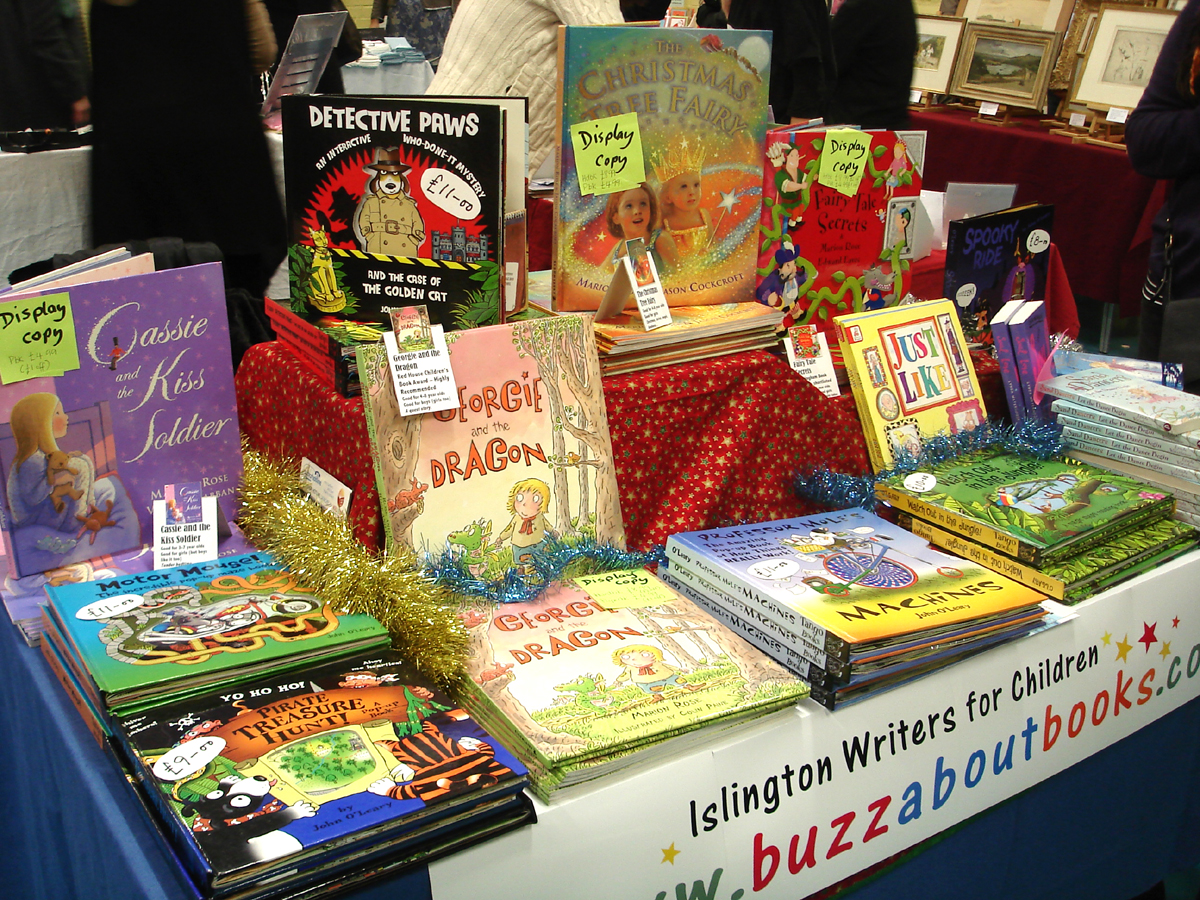
Islington Writers for Children (IWFC) were out in force yesterday evening (well, three of us were), when Marion, Lynda and I braved the severe weather conditions to advance the cause of children’s literacy, promote the blog and sell our books.
We set up shop at the annual Christmas craft fair at St John’s Highbury Vale School, where, despite the snow, there was a good turnout at, what proved to be, a thoroughly enjoyable event – something definitely worth doing again.
JOHN O’LEARY
Miriam Halahmy : Ready to start writing?
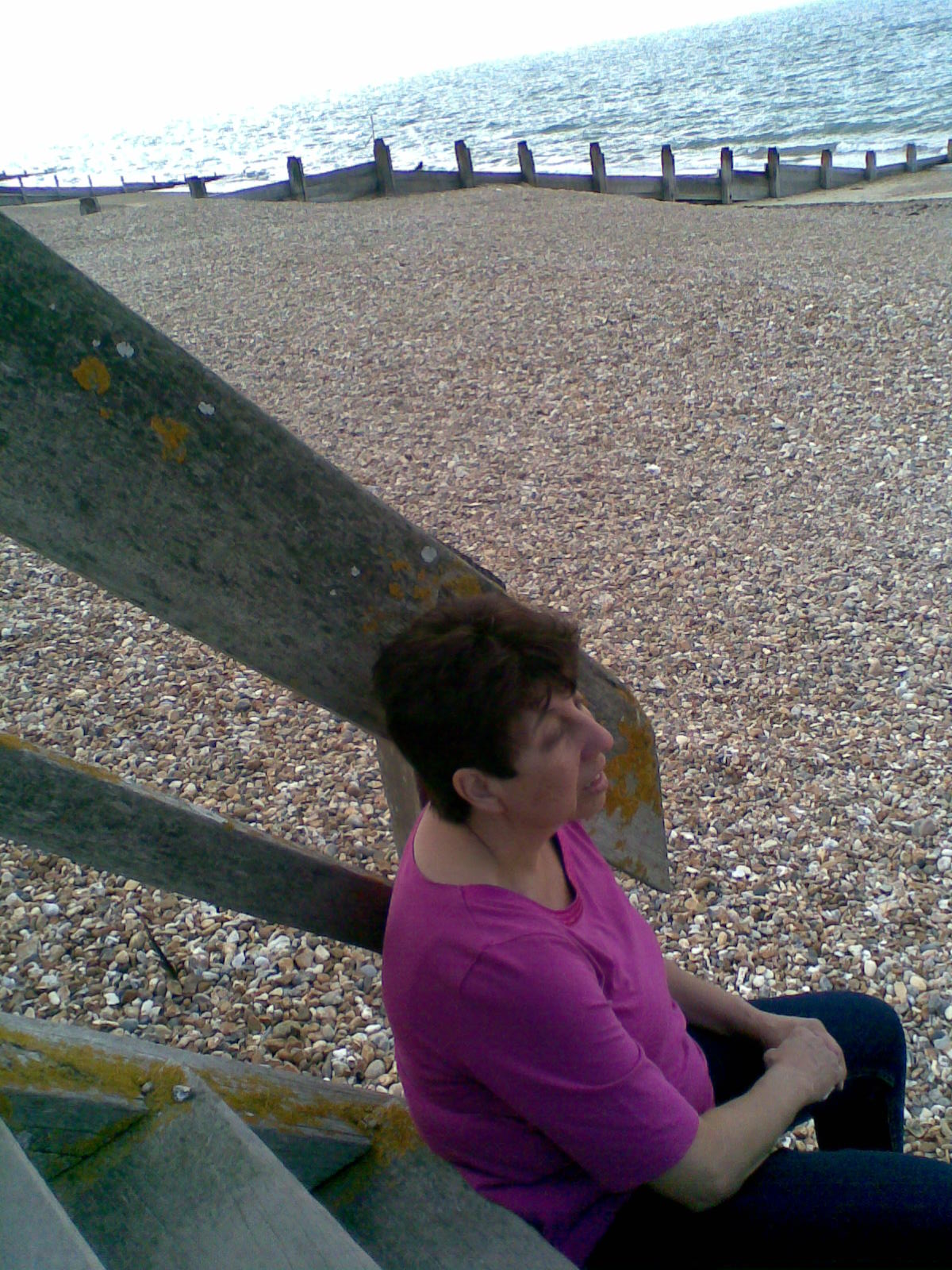
Thinking about my novel on the beach.
In the Guardian this weekend, Kathryn Schultz, writer of the Guardian First Book Award for Being Wrong, Adventures in the Margin of Error, said, “One of the best pieces of advice I ever got was that I’d be ready to start writing( my novel) when I could outline it on a Post-It note.”
This was not the way I started to write the three novels in my Hayling Cycle (first title, HIDDEN ,Meadowside March 2011.) I started with a thought. I was walking on the beach where my parents used to live on Hayling Island. I had been doing a lot of work with refugees and asylum seekers and had published both fiction and non-fiction on the subject. A thought came into my head. What if a couple of teenagers were walking a dog here and they found an illegal immigrant washed up on the beach?
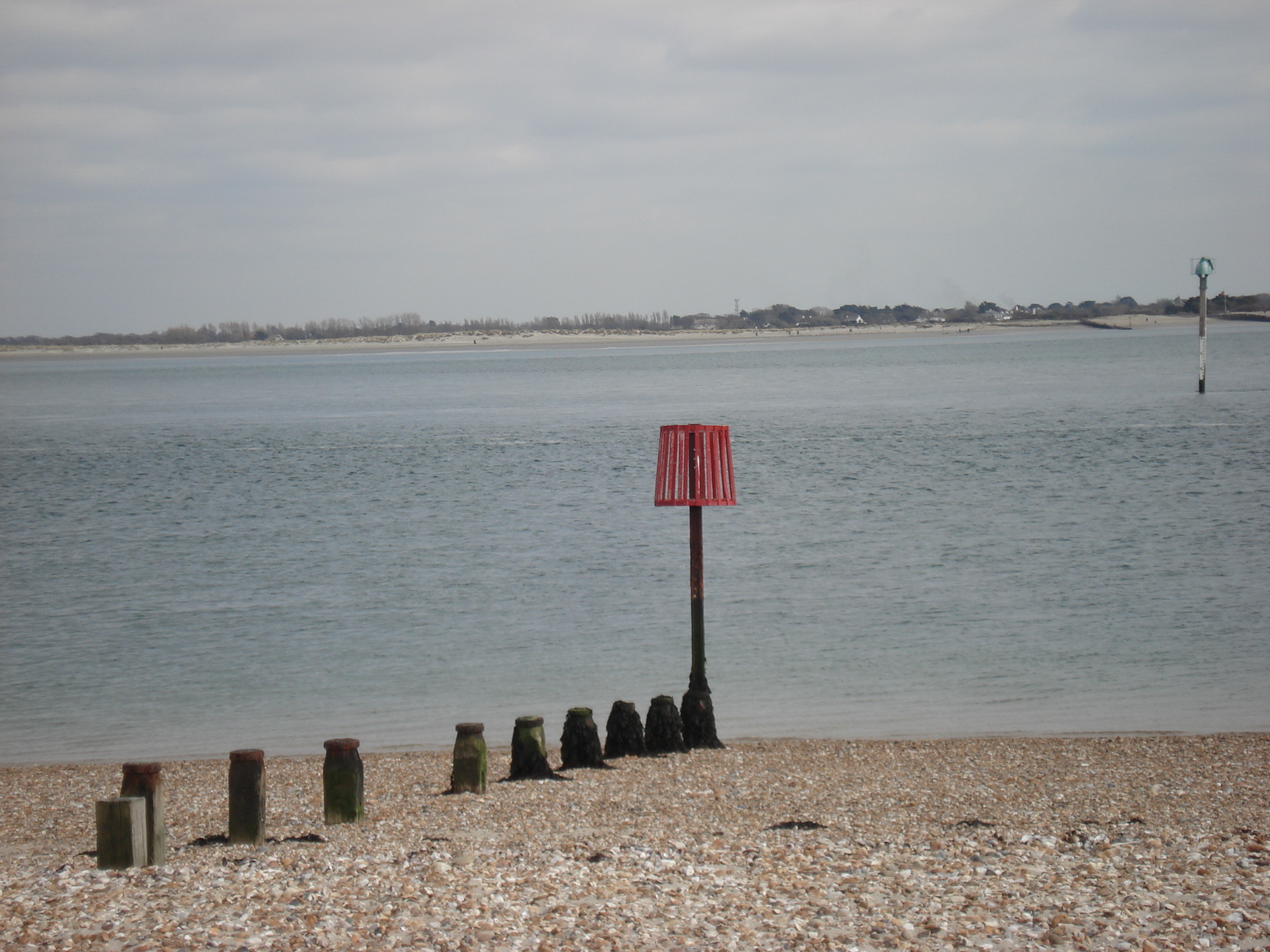
Hayling beach.
That was enough to get me started on my first Y.A. novel. I hadn’t even heard the term Y.A. at that time. But gradually I met other Y.A. writers, some well known – Meg Rossoff, David Almond – and many wannabees, like myself. My novel began to take shape and as I was writing a new idea began to form and then a third. But I certainly didn’t have my novel crystallised into the one-line pitch sentence so beloved of agents and editors : Example – Artemis Fowl, Diehard with fairies. Brilliant.
Then I met the writer, Julia Golding and attended a talk by her. I had already complete HIDDEN and was looking for an agent. I had begun the second book, ILLEGAL, and was planning the third, STUFFED. Julia told us that we absolutely must be able to describe out novels in one sentence. Impossible, I thought. You have ten minutes, she told us and then we’ll share. Crikey! Where to start?
But it was one of the best writing exercises I ever did. Here is my one line pitch for HIDDEN : Two teenagers find an illegal immigrant washed up on a beach and hide him to save him from being deported.
This may not be the place I want to start writing my novels but it is certainly the place I want to arrive at and the sooner the better. When are you ready to start writing?
It’s not big and it’s not clever
By Alison Allen-Gray
In Monday’s Guardian, Benedicte Page reported on library cuts and job losses. The Chartered Institute of Library and Information Professionals (CILIP) fears that around 6,000 members could lose their jobs over the next four years. Councils may look to ‘volunteers’ to step into the breach. Not so long ago there was the jolly little suggestion that ‘libraries’ could be set up in pubs or churches (never mind those members of our society who prefer not to set foot in either). School libraries too are under enormous pressure and some heads are actually closing them. We live in dangerous times.
Perplexing times, also. You could grab any politician by the scruff, plonk him or her in front of a camera and ask for thoughts on literacy. He or she would be sure to oblige with impassioned proclamations on education. But where’s the political protection for the professionally-staffed libraries that underpin learning? It was The Public Libraries Act of 1850 that gave us the UK library system as we know it today. Where’s the optimism, self-belief, joy in discovery and pure altruism that inspired this? We need these things more than ever in straightened times and we won’t get them back by hacking away at the roots of learning.
Yes, we have E-readers, we have the Internet; some argue that because of the advance of new technologies we no longer need libraries. It shouldn’t need saying that some people can’t afford E-readers and computers or that some children grow up in homes with no book in sight. Libraries are the only places for these things to be freely provided. They are hubs of human interaction and possibly the most democratic institution we have. Their only vested interest is to disseminate the things we need to make our lives civilised and each and every one of us has the right to enter and share the treasures that exist there. We have a highly skilled professional workforce who can guide, support and enrich our explorations. It’s insulting to suggest that all this could be replaced by volunteers proffering dog-eared paperbacks to the punters in the pub. This is not the stuff of a Big Society.

Me with my team of advocates for Lifegame at the Bolton Book Award
This summer I had the privilege of going to the Bolton Children’s Book Award, for which my novel Lifegame had been shortlisted. The event is a collaboration between Bolton school libraries and the University, which itself has a creative writing degree. Local sponsors get involved and the Mayor throws open the Town Hall to hundreds of children and their parents, who come to hear groups of pupils put forward their views on the shortlisted books and say which one they want to win. The excitement was palpable, the eloquence impressive and the joy of discovery that buzzed around the ballroom was truly uplifting. Yes, a wonderful party such as this could have been organised by volunteers. But the point is that underpinning the children’s evident passion for books and reading was the knowledgeable, professional guidance and support of librarians. If we lose all this we shall become a very Small Society indeed.
Our fellow children’s author Alan Gibbons is running a Campaign for the Book and is an eloquent and passionate defender of libraries. You can sign his Charter and read his blog on alangibbons.net
Elizabeth Hawksley: Treasure Trail
Have you even wanted to get inside the Bank of England, Lloyds of London or go back stage at the National Theatre? Once a year, on the third weekend in September, London Open House weekend allows you to do just that when a huge number of public buildings – and some private ones – open their doors to the public.

RSA
This year, I found myself at the RSA: Royal Society for the Encouragement of Arts, Manufactures & Commerce in 8 John Adam St, which was built by the Adam brothers in 1774. The RSA was founded in 1754 as an Enlightenment response to the industrial revolution, and it became a force for social progress. Unusually for the period, men and women were admitted on equal terms from the beginning.When I went in I was offered a Treasure Trail quiz to do. Of course, it was really aimed at children but I like quizzes; they make me look closely at things. So, as I went round, I peered at cornices and ceiling roundels and did my best to answer the questions – some of which entailed looking very closely indeed for things which were sometimes hard to find. I handed in my quiz at the end and forgot all about it.

Adelphi ceiling
The RSA comprises 2,4,6 and 8 John Adam St, together with 18 Adam St, originally the Adelphi Tavern and later the Adelphi Hotel. In Dickens’ Pickwick Papers, Emily Wardle fled from her angry father and met her lover Mr Snodgrass there. I like to think of them admiring the ravishing Adam ceiling with its delicate plasterwork and painted panel showing Pan celebrating the feast of Bacchus.Numbers 2 and 4 were originally private houses, and very pretty they would have been, too, with their classical Adam dimensions, elegant staircases and carved Adam fireplaces. No 4 still has its wonderful painted Adam ceiling.
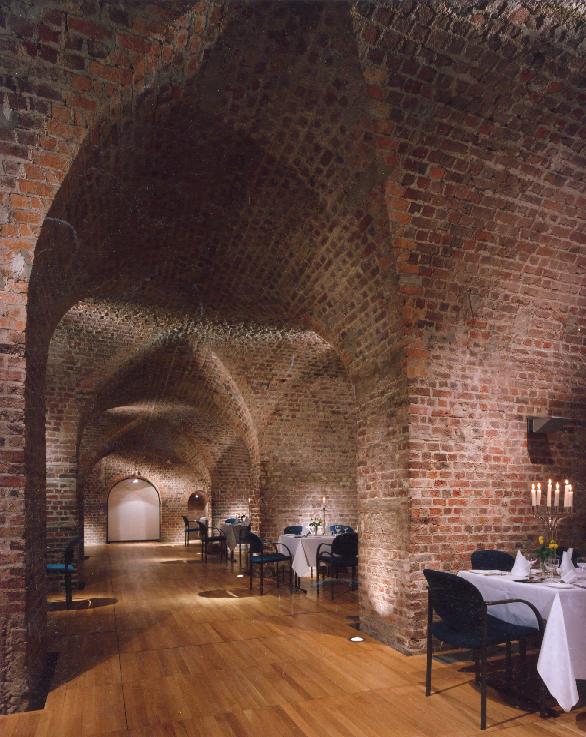
Vaults
Last week, out of the blue, I got a letter from the RSA. It read: Congratulations! You have won the RSA Treasure Trail Competition. Enclosed was a jigsaw of an eighteenth century print of the Great Room and a cartoon book about Benjamin Franklin, an early member. I was tickled pink.Pictures courtesy of the RSA. www.theRSA.org
Sammy Goes Flying (Again!) Odette Elliott
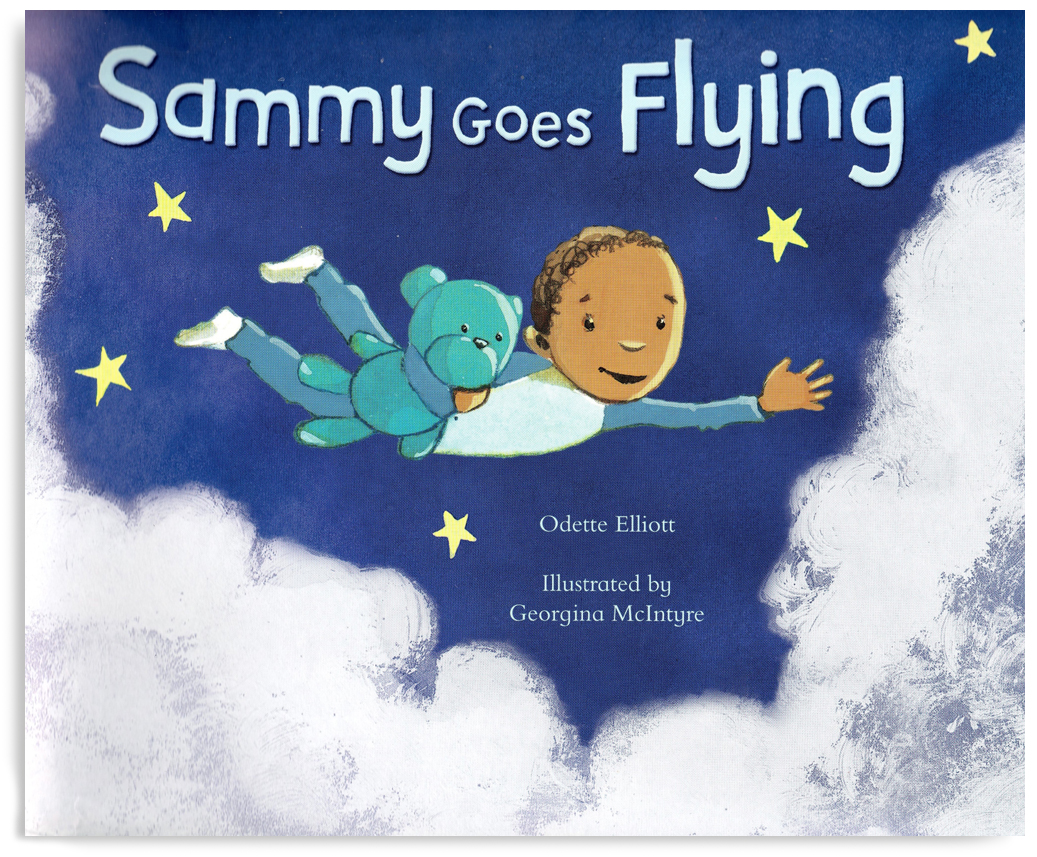 In 2009 I had the rights of my four “Sammy” picture books reverted to myself.
“Sammy Goes Flying” was first published in 1990 by Andre Deutsch then by Picture Puffin in 1991. It was also broadcast on Playbus by the BBC and transmitted in many other countries. In 2010 I received a contract from Tamarind Books to publish it in a new version, with a different illustrator.
The text was to be pared down. I enjoyed that process, with ‘give and take’ by the editor and myself. It took many exchanges of emails before we finally agreed on the words. I think the end result is better than the original.
I spent a long time wondering what “my” Sammy would look like in the new version. It was almost like sending one of my children to an unknown person to dress them up in clothes I would never have thought of. But it was even more drastic, as the face would be different!
I shall never forget the day I received the pencil roughs. I liked them. I then had to wait and see what colours Georgina McIntyre, the artist, would use. Fortunately, once again I was happy.
The next test will be whether young readers will again enjoy the story. The book is due to appear April 2011. I am hoping that the new “Sammy” will emerge with flying colours.
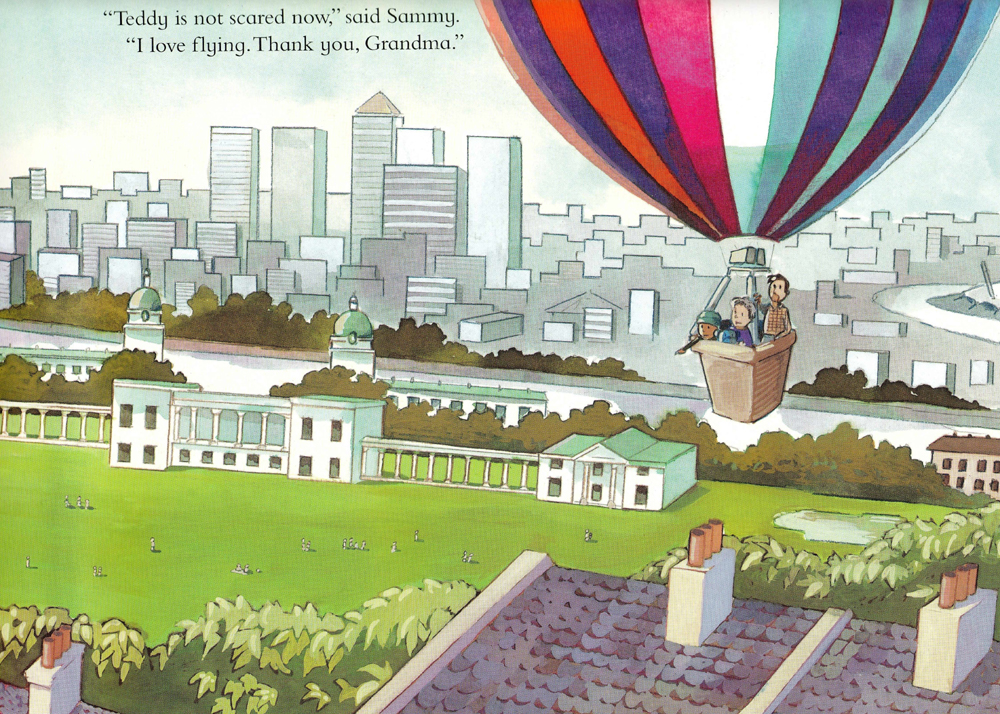
Hoorah. I made it!
Hello everybody, just to let you know that I have made my way onto the blog post website. I hope to post something a little bit more scintillating next time.
Rita
 Buzz about Books