 Our group turned out to celebrate the opening of a lovely re-worked piece of greenspace, Arundel Square in Islington on Sunday (Marion Rose, Lynda Waterhouse , Paul Willcocks, and me). The actor, Rupert Graves, and his family were kind enough to lend us a bell tent (I want one now!) to read our stories in, and children drifted in and out. I took a few photos of Marion and Lynda reading (well, actually, my daughter took the best ones), and enjoyed watching the many children listening to my friends read out a few stirring tales.
It set me thinking, as well, about the links between places and stories. I’ve been researching my next story for children, going back to my Persian roots and reworking a version of the Arabian Nights flying carpet for modern children who hail from more than one place. One of the books I’ve read during this early stage – I like this stage, when I’m reading, watching films (everyone should see Lotte Reiniger’s take on the Arabian Nights, Prince Achmed, the first ever full-length animation), talking to people about the idea, before getting grumpy and retiring with a notebook – was published by Frances Lincoln, which also published my picture book, Fussy Freya a while back. It was called Tales told in Tents, and it was a collection of stories told by nomadic peoples along the Silk Route which runs through Afghanistan, the many other Stans, Iran and, of course, China. One of the writers described the way that nomadic people there sit in tents, the women in one half of a horseshoe, the men in the other, with a fire or a storyteller in the middle. And often the place where they sit is quite precisely located by a carpet, a physical home from home which you can roll up and take with you. Stories, the writer explained, are the golden threads that connect us to each other, and down 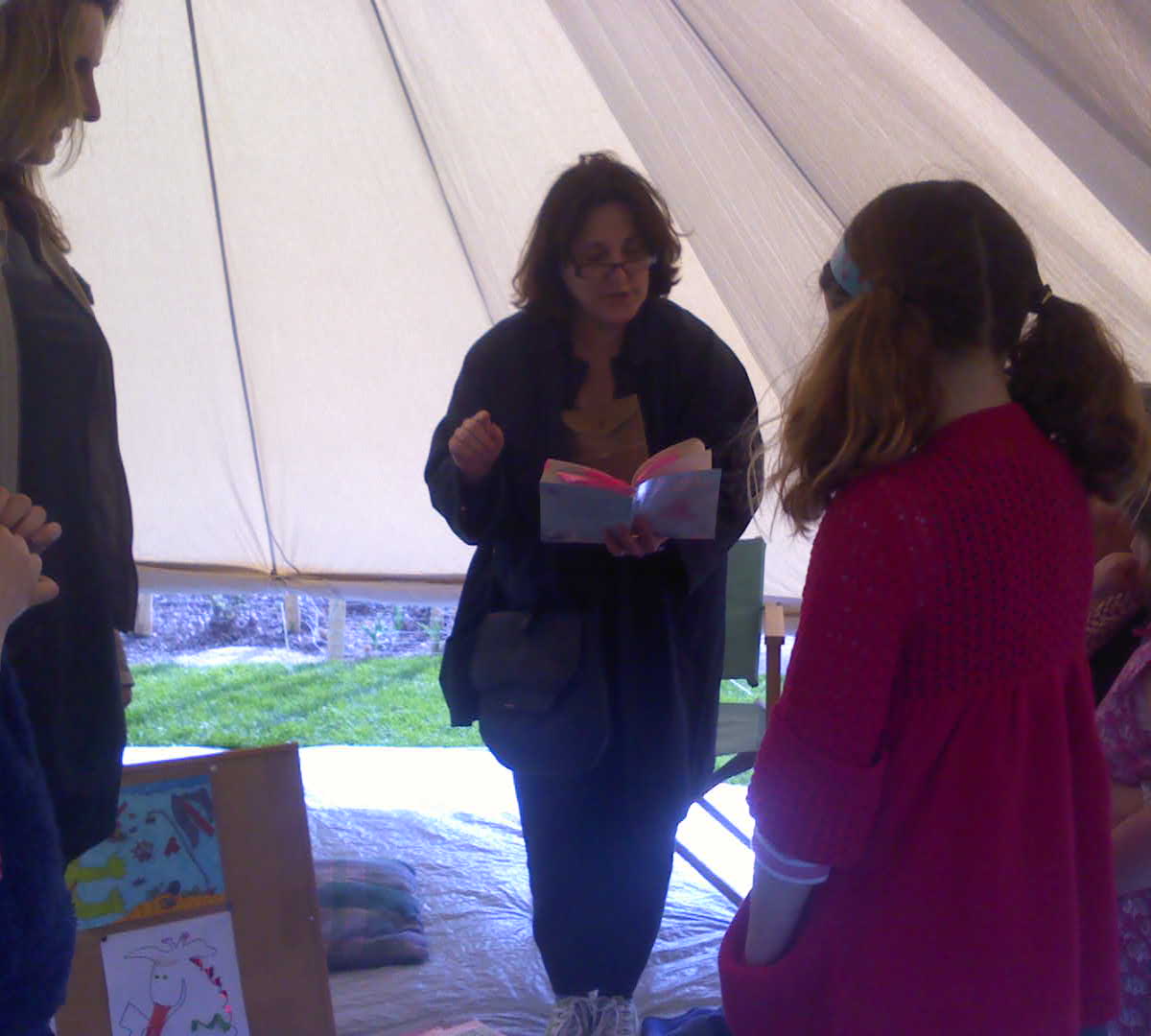 generations too. That’s particularly poignant for nomadic peoples, for stories may be the one possession that they can hold on to, especially in times such as these, when so many countries along the Silk Route are riven by war. The other interesting thing, for a writer who likes to make sure that girls get their fair share of adventure, was that there are many tales told of feisty girl heroines along the Silk Route, who save their families, friends, or peoples from disaster.
So there’s something pretty special about tents, stories and, of course, their tellers (for many peoples speak their stories, just as they weave their carpets, from memory; nothing is written down). Next time around, though, I might bring a carpet too, so we can fly somewhere together – after the grumpy stage is done, of course, and the story written.
April Fool’s Day
NIKKI BIELINSKI
So it’s April Fool’s day. Besides the odd (usually annoying) prank by someone else, I’ve never given it much thought. A quick Google filled me in.
There are many different theories and historical assumptions, that interestingly, span many cultures and countries. This made me wonder, is there a need in the human psyche to poke fun? Whether it’s a relief of pent-up tension, plain old bullying, or just remembering the lighter side of life. In several places, servants would traditionally swap roles with their masters for a few hours – humbling, a laugh, the Lord of Misrule in action, with chaos showing us the lighter side of life. The Romans celebrated a festival on March 25 called ‘Hilaria’, where they had masquerades and “general good cheer.”
One popular theory about the origin of April Fool’s Day involves the French calendar reform. In 1564 France (keeping in with other nations), moved the start of the year from the end of March to January 1. Those who didn’t to keep up with the change, who clung stubbornly to the old calendar system had jokes played on them. Pranksters would sneakily stick paper fish to their backs – Poisson d’Avril, or April Fish—which is the French term for April Fools.
Shakespeare, who delighted in fools in general, wrote in the late sixteenth and early seventeenth centuries, made no mention of April Fool’s Day, so was it a tradition here at that time?
It made me wonder, where in children’s fiction is this notion of making a fool of someone or making fun of them (beyond bullying) explored? I pootled around in my brain for a while before I remembered Anne Fine’s ‘The Tulip Touch’. If you haven’t read it, do. Although not an April fool’s story by any stretch of the imagination, it is a chilling reminder/exploration of how humanity can use a ‘prank’ to cause real pain, while the joy of schadenfreude leaves Tulip hungry for more… far beyond the mutual release of tension when servants swapped roles with their masters for a few hours.
Reactions to a Face
PAUL WILCOCKS
Taking two extracts from teenage novels which include incidents of a boy waking up to find a disfigured face, I was touched by the reaction of the students in the all girl’s school where I teach.
 My year 9 Drama class listened in captivated silence to the extract from the recently published ‘Boys Don’t Cry’ by Malorie Blackman (Doubleday 2010) when Adam, a gay teenager, asks for a mirror to study his face after a vicious homophobic attack. They also listened spell-bound to the extract from ‘Face’ by Benjamin Zephaniah (Bloomsbury 1999) when Martin, recovering from a car accident which has left his face with horrific burns, insists on having a mirror against the wishes of the hospital staff.
I juxtaposed the two extracts to show that the same scene can have two entirely different treatments by an author – and to encourage them to consider how they would like to tackle a scene like this when dramatising it for the stage.
The main focus of ‘Boys Don’t Cry’ is Dante and his journey to becoming an effective single father, after being ‘dumped’ with his baby on the day of his A Level results. Adam, his brother, has his face pummelled by Josh, a ‘friend’. Adam’s reaction to his disfigured face is brief. It is related from Dante’s point of view, who observes his brother’s long silence as he stares in the mirror. Blackman is interested in Adam’s withdrawal from the world impacting on Dante, so we do not really get to be inside Adam’s head at this point.
 In ‘Face’, the whole procedure is painstakingly described and extremely moving. It is related in the third person but Zephaniah takes us right inside Martin’s head as he examines his completely altered features. There is almost an absurdity to the scene as the doctors, his therapist and his family all react badly to the news that Martin wants to look in a mirror. The unwrapping of the mirror is related as a ritual. Martin’s eventual study of his reflection lasts almost two pages. It is a powerful section of the book and handled very sensitively by the author.
Inspired by these two stimulating extracts, the students created hospital scenes exploring real/fake friendships, loyalty, formalities, bravery and the use of an inner monologue. Their appreciation of the power of silence on stage increased for many groups included a still image or a long hold as the patient looked in the mirror. The stillness that one girl achieved when waiting for and eventually holding the mirror was very powerful.
One group made a paper mask to represent the disfigured face, which at first surprised me as it threatened to lean towards comedy, but they clearly showed that they appreciated the themes of ‘unmasking’ and cleverly made the point that it was the patient’s friend who was wearing a mask when reacting (or trying not to react) to the face.
The following lesson, as I was welcoming and settling my (at times) rather boisterous class, I heard a voice in my ear say ‘Sir, I’ve bought the books and I’ve started ‘Face’. I’m going to read ‘Boys Don’t Cry’ next’.
‘That s great,’ I said, my attention diverted by a couple of students who had forgotten how to sit in a circle. Often, when you are teaching, you run out of time to talk one-to-one to students about their reactions to a lesson, but this one was heart-felt and very encouraging and I can’t wait to hear her reaction to both novels.
Elizabeth Hawksley: Books for Boys

Archie's War by Marcia Williams
One of my favourites was Archie’s War, engagingly written and brilliantly illustrated by Marcia Williams, which is aimed at boys of eight plus. It opens in 1914. Ten-year-old Archie Albright lives with his family in London’s East End. He loves comics and is thrilled when he is given a scrapbook. He decides to create his own comic book. This proves to be a brilliant format for getting across what life was like for ordinary people during the First World War.
Archie collects whatever he can get his hands on: newspaper cuttings, cigarette cards of the period, picture post cards from the front, railway tickets, his Dad’s letters from the trenches, and his own diary and drawings. We see his family’s enthusiastic patriotism at the beginning (apart from his sixteen-year-old Pacifist sister); his Uncle Ted joins up amid great enthusiasm; the innocent Schoenfeld family who ‘might be spies’ are ostracized. Gradually, the tone changes as Archie realizes that the war won’t be over by Christmas.
The news gets darker. War-time shortages begin to bite; then Uncle Ted is killed. Archie’s father joins up, as does his fifteen-year-old brother, Ron. Sometimes, Archie’s scrapbook records local news: the explosion in the munitions factory where his mother works. Sometimes it has more general news, such as the story of Edith Cavell.
The arrival of the first Zeppelin brings a new threat. The Zeppelins are slow and not too dangerous but then come the first German bombers. Archie is excited by the exploits of the Red Baron, but horrified by what bombing actually does to people when the street behind them is bombed and his friend Tom is made homeless.
I give Marcia Williams top marks for the intelligent, funny, sad and thoughtful way she charts the First World War through the eyes of one ten-year-old boy. I particularly like the way she charts the gradual shift of emotion as Archie realizes that war is about more than simple patriotism. I thought the bookt was terrific.
There are plenty of high-calibre authors out there writing for boys and they are doing a great job. What we need now is for public libraries to remain open and be funded properly so that they can buy books like Archie’s War to help boys get the reading bug.
Utopias and Dystopias
KATHARINE QUARMBY
I’ve been thinking for some time now about Utopias, having just finished my book for adults, Scapegoat, on how disabled people are viewed and how this has made so many disabled people targets of horrendous crimes. One of the reasons for this, strangely, is the continuing influence of Greek Utopias, particularly those of Diodoros of Siculus and Plato. They both envisioned Paradise as being a place where disabled people either didn’t exist, or from which they were expelled. More recently, of course, in Lord of the Flies, by William Golding, which I re-read last weekend, children with impairments (birth marks, myopia, obesity, mental illness), were the first to be targeted. So I thought perhaps it would be interesting to write about a new and up to date Dystopia, in which disabled people were frowned upon and expelled. I wondered whether there was a way of writing about Dystopia that appealed to a general audience, perhaps through the medium of cosmetic surgery, and all children having to go under the knife before they were allowed to join adult society. And….I found out that I was too late. The wonderful writer, Scott Westerfield, has already written a trilogy (plus one) on the subject – and has a movie coming out soon as well. In his book, Uglies, he writes about children being forced to undergo cosmetic surgery so that they become part of the body beautiful cult – and, of course, some resist. So it’s back to the drawing board for me, though I think there’s room for writing something that is more focussed on disability and Utopia. However, my warning to myself is this: the story’s the thing, and not the message. So I need to find the story that works, before I work on the message. That’s the hardest part to get right, but it’s important not to be too didactic, otherwise the story will disappear under the message. So it’s back to the drawing board for me…
Once Upon A Wartime
 To the Imperial War Museum where five children’s war books are the starting point for exploration in Once Upon A Wartime.
First up is ‘Warhorse’ by Michael Morpurgo. Paintings that inspired the author are on display as well as accounts of what happened to horses on the western front. What is most interesting is an original manuscript of Morpurgo’s typed early draft together with scribbled emendations he added when forwarding to the publisher.
The next three books are linked to the Second World War. The displays on ‘Carrie’s War’ by Nina Bawden includes photographs of the author as an evacuee and even her old teddy bear which was thought to belong to her brother until an old photo revealed it had been hers. The children I was with were most intrigued by the mock-up of Hepzibah’s kitchen.
‘The Machine Gunners’ exhibition included a mock-up of an Anderson shelter which children can climb into, including pasted up strips of wartime comics with characters like Patsy Potter being overwhelmed by a soldier’s cigarette smoke! Again, a typed draft of the author’s work – Robert Westall – is on display, this time with pencil notes from the editor advising a tightening of dialogue. Westall’s Carnegie Medal is also on show. A play based on this novel is currently on at the Polka Theatre.
The fourth book, ‘The Silver Sword’ by Ian Serraillier, is a book I found haunting as a child and it was wonderful to see the actual silver sword on display – it was a letter opener which the Serrailler received in the post as a gift whilst working on his book. Serrailler chose to use this letter opener as the symbolic thread that binds the father, who has escaped from the Nazi, with his lost children in Warsaw.
The fifth book brings us more up to date. Called ‘Little Soldier’ by Bernard Ashley, it is set in a fictional African country torn apart by war. A boy’s family is wiped out by a Yusulu government troops. When the boy – Kaninba Balumba – is sent by the Red Cross to England, he meets, in his East London classroom, a Yusulu boy refugee. Does he take revenge? The exhibition presents many of the dilemmas facing the boy as he struggles with the ghosts of his past. What was most disturbing about this book is that it reminds us that war and its horrors are ever-present.
It was noticeable that many of the writers in this exhibition were teachers who initially wrote in their spare-time. Westall wrote his book ‘The Machine Gunners’ to interest a nine-year old; he read it out to him and cut out the bits the boy found boring. The manuscript was then left in a drawer till a friend convinced him to send it to a publisher.
The two ten year olds with me at this exhibition found the activities stimulating, from quizzes to interactive models, and particularly liked the Anderson shelter. They were very intrigued by ‘Little Soldier’. You can hear the authors talk briefly about their work in each section. Ashley’s account of re-finding his equilibrium at the end of a long day by writing struck a particular note with me.
It was fascinating seeing the authors’ old typewriters on display and I wondered how much using typewriters affects the number of drafts an author works through, as opposed to laptops and computers. I also became interested in how much wars from earlier centuries are represented in children’s books. ‘It would be hard to grab their attention,’ said a friend who was with me. I wonder…
Elizabeth Hawksley: Creative Writing – a poignant exercise
I’ve just returned from the Writers’ Weekend in Fishguard where I took the Novel workshops. One of the workshop topics was Description – a topic which, I believe, has an important part to play in getting across emotion, amongst other things.
The final exercise shows this perfectly. I asked the group to describe their favourite childhood toy and this simple exercise obviously touched an area of deep emotion. There were several much-loved teddies, a wonderful rocking horse, a toy bus whose route followed the pattern on the carpet and so on, all deeply felt and some very sad.
Afterwards, I found myself thinking of my own teddy bear, a koala, much loved and hugged threadbare. The only bits of fur left were in the creases of his arms and legs. He also had a visible scar across his tummy sewn up in dark blue blanket stitch.
When I was about nine, I went to France with a twelve-year-old cousin to stay with a French family in Normandy. We flew, unaccompanied by an adult, on a small plane that hopped across the channel. The French customs officer thought our unaccompanied state highly suspicious. He grabbed my teddy and prodded him. Then, to my horror, he cut him open and pulled out the stuffing. I burst into tears.
Fortunately, my teddy was found to be innocent. Other passengers who were watching began to protest and the man pushed the stuffing back in roughly and handed him back with a large rip in his tummy and the stuffing showing. It felt as if he’d been murdered.
I have never forgotten it.
Save Our Libraries Day
by Judy Cumberbatch
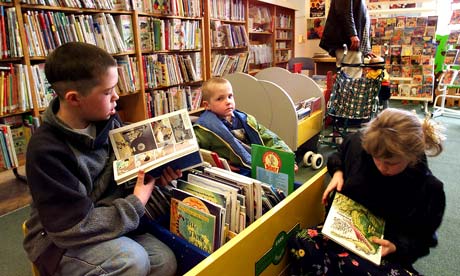
Are public libraries an unaffordable luxury?
As I look at a little girl in a pink flowery mac, proudly clutching her book, as she leaves Islington Central Library today, I can’t help thinking what a wonderful thing a library is and what a terrible place the world would be without them.
When I was a child, living in the far north of Ghana, the arrival of any unusual car or truck in the hospital compound, where my father worked, was the cause of excitement. There were two vehicles, in particular, which I can still vividly remember, the large square-backed, dark green mobile dentistry which left such an abiding memory on me that I still feel a pang of disquiet when I see something similar. The other was the mobile library.
It came every three months and parked outside the outpatients department in the shade of a tree. We would line up in the hot sun and then when it came to our turn, mount the three steps into the van. Inside it smelt of books, felt books, was books, tiers of them, neatly shelved, treasures waiting to be found. We were allowed fifteen books at a time and I would spend ages pulling titles out, replacing them and pulling them out again until it was time to leave. Then I would scurry home with my booty, trying to work out which one to read first, before immersing myself in a magical world of stories, people and landscapes that were far distant from the world I was living in.
I have loved libraries ever since, not just iconic places like the great round reading room of the old British Library and ancient college libraries, which I have been lucky enough to visit, but public libraries up and down the British Isles, from those that open only a couple of days a week, to others housing rich archives of materials on anything from local history to shipbuilding.
Today, on Save Our Libraries Day, I realize how much I take my library for granted. I hardly ever think about how lucky I am to have it; I pop in whenever I want, order much of what I want or just browse. But for how much longer? Libraries have become a threatened resource, no longer regarded as an essential and ever present part of our communities. In some areas, they are being closed completely. Most are seeing their budgets, staff and holdings cut right back.
Once libraries are closed, they will not be opened again and many of tomorrow’s children, let alone adults, will never know the joy of taking a book out from the library.
I’ll leave the last word to Philip Pullman, who, as ever, puts the point so well:
I love the public library service for what it did for me as a child and as a student and as an adult. I love it because its presence reminds us that there are things above profit, things that profit knows nothing about, things that have the power to baffle the greedy ghost of market fundamentalism, things that stand for civic decency and public respect for imagination and knowledge and the value of simple delight.
Plot
NIKKI BIELINSKI
Plots are always rather elusive for me. Characters, context, fantastical inventions, supernatural interventions can fill notebooks on my shelves and scraps of paper under my desk. Unfortunately, a wad of paper the size of a book, does not a book maketh. I sometimes pick apart stories and make spreadsheets of plots, subplots and character development. All very interesting, time-consuming and keeps me away from my own writing. Super. Not the point though is it? So I read Terry Pratchett books and try and find the connections between the connections. It’s like a three-dimensional spiderweb with Tiffany Aching in the middle. I think I need to travel to the fourth dimension though to get a clear, hindsight perspective that would allow the connections to spark off each other, culminating in a wow factor.
I’ll let you know…
Can’t write, won’t write
by Miriam Halahmy
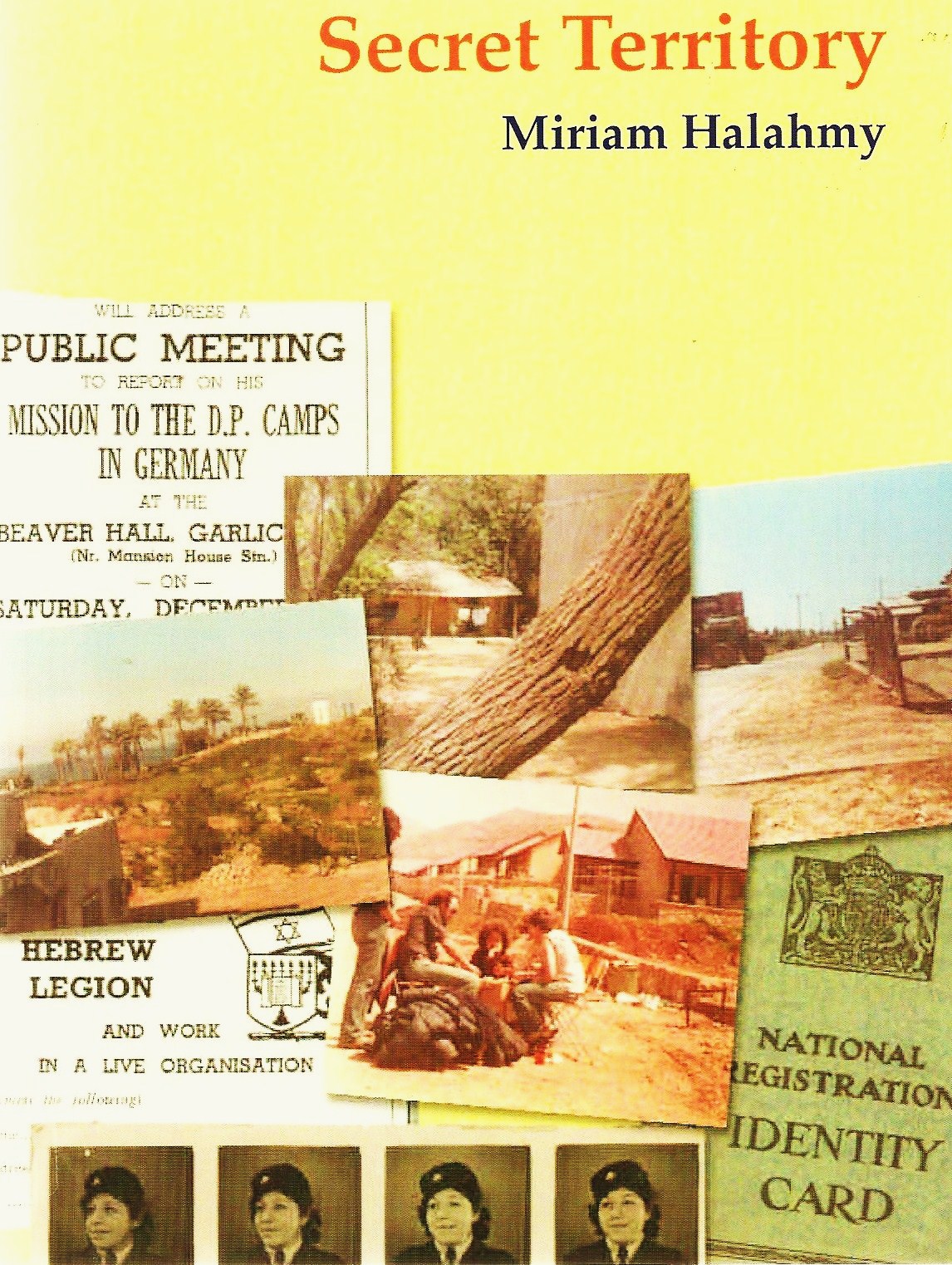 Is there ever a real excuse for not writing? I’ve heard so many over the years but I do believe that if you have the writing bug you will find the time. I wrote my first novel, Secret Territory (Citron Press, 1999) on the kitchen table after the kids had gone to bed. It took me three years but then, I was also working out how to write a novel. There were no M.A. courses in Creative Writing to help me on my way when I was writing the book in the late 80s, early 90s. It took a while to get it published too.
But as we all know there are so many pressures on modern time – kids, commuting, work, social networking, writing blogs – and yes, I’m writing this blog instead of getting on with the WIP. So what are my tips for getting over those times when there just isn’t acres of space to write?
MIRIAM’S TIPS TO GET YOU WRITING
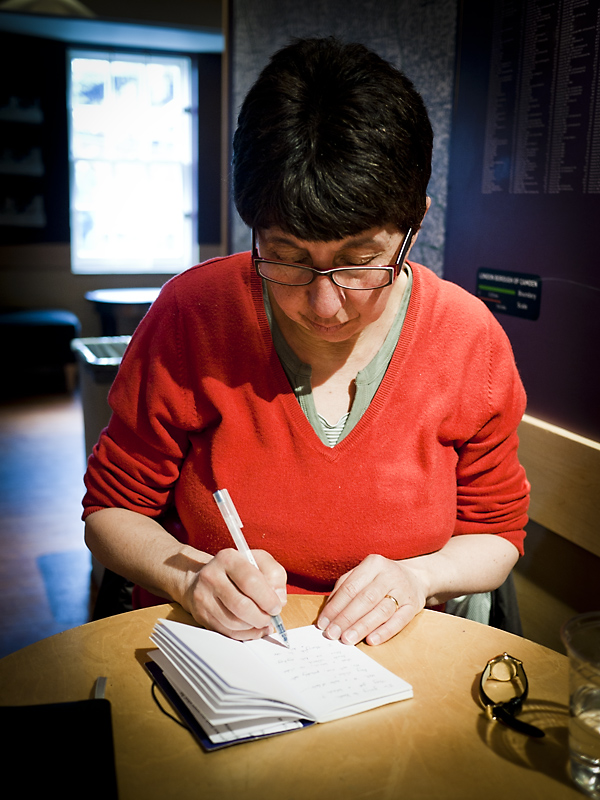
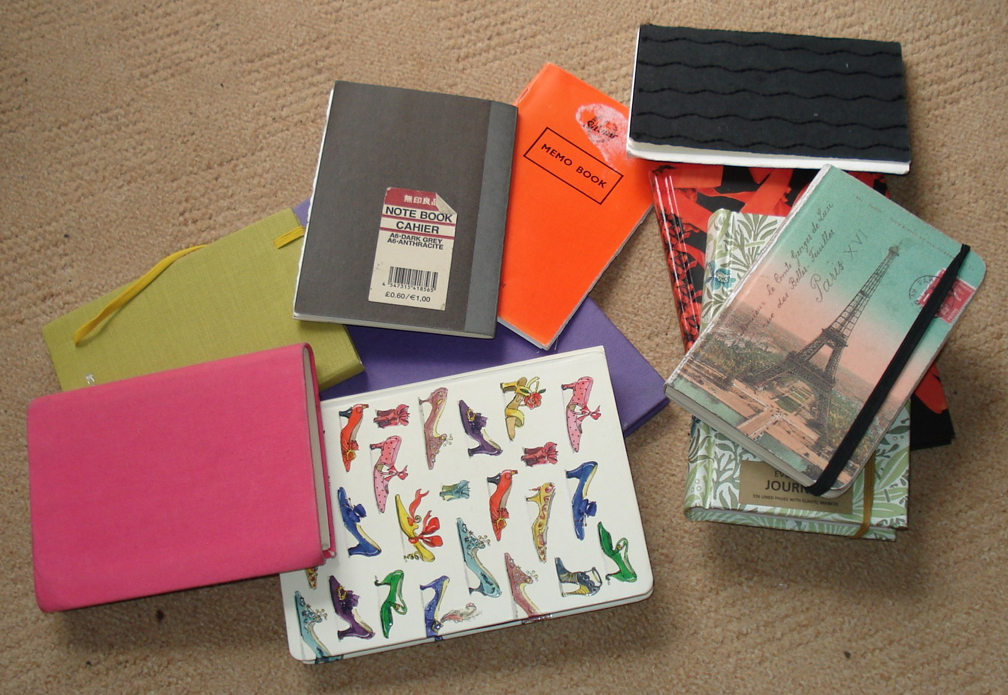
- Carry a notebook. There are loads of times – standing at the bus stop, grabbing a quick coffee in McDs – when you could whip out a little notebook and write a scene, describe a character, colour in the background. Those little snippets will keep your imagination oiled for the longer times of writing.
 The half and hour rule. You know how rubbish you feel when you haven’t written for days and days because you can’t find a solid two hour slot. My answer? Make yourself sit down for half an hour and write every day. I promise you there will be a huge feeling of relief and this will keep you in the positive writing mood for those longer stretches when you can win them back.
- Bum on seat. Lots of people start to drift away from their writing when they hit a snag. I used to be the same. But now I absolutely refuse to leave a piece of writing until I have overcome a problem. I literally glue myself to the seat. It’s the only way, otherwise you dread picking it up the next day, knowing that mountain still has to be climbed.
 HAPPY READING/HAPPY WRITING – you know it makes sense!
 Buzz about Books