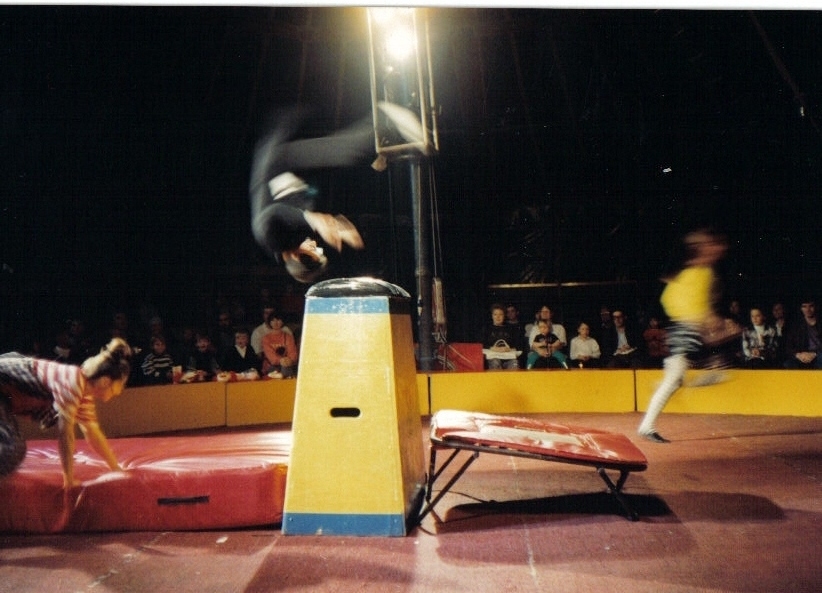
- I was eaten by the devil at the Royal Opera House in 1992. But I got regurgitated.
- I am a fan of ‘Doctor Who’ and have been ever since I was four.
- I don’t drive. I almost wrote ‘I can’t drive’ but I sure that can’t be true.
- I am afraid of spiders; of their agility, their many legs, their unpredictable speed… I admire them though.
- I love Japan and in particular the youth hostel in Hiroshima.
- I have a terrible weakness when it comes to Pringles.
- I am both extravert and introvert and can switch from one to the other like a roadrunner.
-

Me in Zippo's 1993
I am a fan of ‘The Apprentice’ and secretly want to be on it.
- I have written over a hundred songs. Some are so close to the bone I just can’t play them anymore
- I have just completed my Grade 6 piano, 28 years after I took my Grade 5!
- When I was 27, I ran away to join the circus. I left when I found myself banging stakes into an icy carpark inReading in the last weeks of November, just to put the tent up.
- My older brother saved me from drowning when I was 7.

Critics applaud Katharine Quarmby’s harrowing and ground breaking first adult book Scapegoat

As The Sunday Times on 13 June 2011 describes in its review, ‘What care? What community? Scapegoat is a shocking story of how the most vulnerable among us are let down by the UK authorities. Further, the review goes on to say. ‘this is a stomach turning book but it must be read.’
Taking four years to research and write, Scapegoat, as Katharine’s press release said, ‘is the first book to be published in the UK about crimes against disabled people. It looks behind the headlines to trace the history of our discomfort with disabled people, from Greek and Roman culture, through the Industrial Revolution and the origins of Britain’s asylum system to the eugenics movement and the Holocaust, the rise of the disability rights movement and the unintended consequences of the move towards community care.
Combining fascinating examples from history with tenacious investigation, deploying evidence obtained through freedom of information requests, as well as powerful first person interviews with bereaved families, senior investigating officers, prosecutors and disabled victims, Scapegoat will change the way people think about disability – and how we treat disabled people.’
Katharine tells Buzzaboutbooks: “This was a very hard book to research and write, but I hope that it will help change attitudes towards disabled people in the UK. Far too many disabled people have been treated as second class citizens, fit to be mocked, attacked, and, in some cases I document in the book, tortured and murdered. This has to stop.”
She adds: “It’s sometimes strange to write children’s books in parallel with journalism for adults, but both parts of my writing career are equally important to me. What I’d like to do now is write something for younger children about diversity and bullying in schools – for many disabled children have a miserable time in schools – and in two of the cases I write about in the book, former school-mates bullied their victims both in school, and out of school – and, in one case, went on to murder the victim.”
You can buy it here.
Elizabeth Hawksley: Picking up the Writing Threads
I’ve just got back to The Changeling after getting on for a year of doing no work on it. I’d stopped writing it in order to finish my adult book Tresillian which took far longer than I thought it would. Now that Tresillian is safely with my agent, it’s time to get back to The Changeling.
It’s not easy picking up the threads again after so long. For a start, I haven’t a clue what’s going to happen. I’d left my main protagonist Alisa in the forest with Tor, a boy she doesn’t like and thinks is pretty useless (he’d had measles as a child which damaged his eyesight). Naturally, Tor doesn’t like her either. All I can remember is that I wanted it to be like a fairy tale and for Alisa to have three tasks to perform. Or, I decided, three things to learn.
I’d left myself a few notes but they’re not very helpful. I’d written:
To value herself/Tor to value her. Tor smell, hearing abilities, e.s.p?
To learn what’s important. Truth
To improvise
On the other side of the page I’ve written
Captured by alien tribe?
Quartz? Something useful. Soapstone? Honey?
Men want Alisa as bargaining point?
Alisa takes her knife? Hides her knife? Doesn’t bring her knife?
I have no idea what I meant.
But on re-reading the story (I have about 14,000 words), I found myself getting involved again. The story grabbed me and drew me in. Ideas began to pour into my head: the What if, and the Supposing which are familiar to all writers. Perhaps it doesn’t matter too much that I’m not sure where it’s going. Maybe all I need is to have faith in myself, to keep on writing and to let Alisa and Tor tell me their story as we go along.
Don’t Let the Penguins Out – Lynda Waterhouse

The gate was already open…
By the time I arrived on the scene the gate was wide open and there was not a penguin in sight. I checked the pond. It was empty apart from one sitting duck and a few fish. All those penguins must have skedaddled over the South Downs or been bundled into that refrigerated van that nearly ran me down on the lane. I wasn’t too worried. I had other fish to fry.
Barkley the dog gave me the once over and when he sniffed out that I wasn’t carrying any meat products or stray penguins he pretty much left me alone.
I couldn’t believe my luck. The fates had granted me not three wishes but three days by myself at Tilton House. Was I thrilled? YAAAHOOOO!!! This was Tilton House former home of economist Maynard Keynes and his Russian ballerina wife, Lydia Lopokova and now run by Polly and Shaun.
I wasn’t thinking straight and I was badly in need of inspiration, a battery recharge and a place to be still and to think.
The sun shone. I walked on the downs and dropped in for the last tour of the day at Charleston Farmhouse which shimmered in the early evening light. I watched the sunset with ponies, lambs, rabbits and a grouse for company. I sniffed roses that had the most delicate perfume. I scribbled in a notebook. I drank too much wine and discovered Sky TV and watched Buffy. I re-read snippets from Judith Mackrell’s wonderful biography, ‘Bloomsbury Ballerina.’ Slowly the tangle of thoughts unravelled, the batteries were topped up and I could see that the thoughts, ideas and plotlines were still there. I just needed some silence to hear them.
I had banished those ‘hardsell, market yourself, maintain your profile, boost your sales, Tweet, push-push-push, pitch, compete’ aspects of an author’s life. Sometimes you have to open the gate and let out those pesky penguins.
Elizabeth Hawksley: Reading Aloud
One year, when I was about fourteen and at boarding school, I won two bronze medals. The first was for a London Academy for Music and Dramatic Art exam, and the other for a public speaking competition (youth section) at the Cheltenham Music Festival. I’m not sure how, because I certainly can’t act for toffee, but I learnt that I was good at reading out loud. There was, I discovered, a knack to it. You had to be able to see a line or so ahead and anticipate which words need to be stressed and to have the confidence to convey the appropriate emotion.
It also helps if you can, somehow, put yourself into the background. You are not doing it to glorify yourself, you are doing it for the author whose work you are reading.
Recently, I was asked to read aloud in extraordinary circumstances.
I have just returned from holiday in Turkey with an archaeological group. We visited a number of classical sites: some famous, like Troy and Ephesus, others little visited, like the ruined city of Priene nestling on a wooded hillside overlooking the river Mæander. I was asked to read an extract from Euripides’ Agamemnon in the theatre there. Greek theatres have fantastic acoustics – guides often demonstrate this by sending visitors up to the top whilst they remain centre stage. They then light a match – and you can hear it clearly.
Naturally, I jumped at the opportunity.
The group scattered about the theatre. I drew a deep breath, told myself that this was for Euripides – a playwright I much admire – and walked onto the stage.
The passage I’d been given was the herald’s return to Mycenae to tell the queen, Clytemnestra, and her lover, Aegisthus, that King Agamemnon is coming home from Troy, victorious. Of course, the original audience (and mine) knew that Agamemnon and his captive, the Trojan princess Cassandra, would be murdered: Clytemnestra had not forgiven him for sacrificing their daughter, Iphigenia, to get a fair wind toTroy. The herald’s speech, therefore, needed an undertone of dramatic irony.
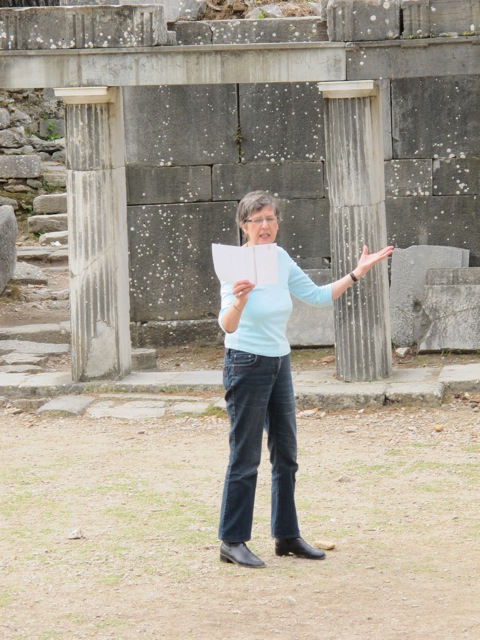 I launched into a paean of victory: I proclaimed, triumphantly – with suitable gestures – that Paris was dead, Hector was slain, andTroy totally destroyed. Agamemnon, King of Men, the son of Atreus, was victorious! (Boasting was obviously part of the herald’s job description.)
Then came my big speech. I raised my arms to heaven and called on Zeus, Apollo and Hermes to hear me. (I could hear my words ring round the theatre in such a way that I half-expected a thunderbolt from Olympus.) I ended with an exhortation: Welcome Agamemnon! Welcome the victor home!
You could have heard a pin drop. It was hugely satisfying.
Photo by Jane Burns
I was aghast…
By Alison Allen-Gray
A few years ago at a conference on children’s literature, I heard a leading publisher announce the intention to produce re-written versions of children’s classics to make them more accessible. My gasp earned me a hard stare (clearly learnt from Paddington Bear) from my neighbour. I was, in the parlance of the stories I read as a child, aghast. My revulsion at the idea stemmed, I think, from two things. One was comradely outrage that long-established authors should be meddled with. The other was a general unease that has to do with obliterating texture from language. I think it is a good thing for children to become aware, through unfamiliar vocabulary and a style of language that is different from their own, that social relationships and attitudes were different in years gone by to how they are now. Absorbing different styles and textures of language as your reading grows certainly helps when you meet the adult classics of, say, Austen or Dickens. In fact, it helps with everything.
However, a conversation with fellow Islington Writers for Children members the other day led me to re-examine my thoughts on this one. I have to concede that I was a fortunate child; if when reading I came across a word I didn’t know I could often ask an adult for clarification. If there was no one around to ask I’d either deduce the meaning by context or, if push came to shove, get a dictionary. The dictionary was a last resort, though, because usually I’d want to press on with the story. And this brings me to the thought-provoking point made by Marion about Enid Blyton: here we have a body of work that is all about driving an exciting story at full pace. Would Enid herself have wanted her work re-written so that outdated language didn’t hold up the story? Other issues, of course, are the sexism and racism that one encounters in some of the ‘classics’. Should they stay or should they go? Is it commendable to banish them from the literature of the past because we are now more enlightened? Or is it an irresponsible dishonesty?
Creative Partnerships
JOHN O’LEARY
One of the Creative Partnership projects I was involved with recently was in Buttsbury Juniour School in Billericay, where I was chosen (by the children, no less) to come on board for a series of literacy workshops with Royal Opera House CP.
I worked alongside poet, playwright and workshop leader, Joseph Coehlo, bringing an illustrator’s slant to the proceedings, in a series of one day workshops with the two yr 4 classes, which involved show-and-tell, pop-up creations and making books.


The idea for a collapsible cardboard toolbox came out of the planning meeting – hit the kids with a pop-up on a grand scale to prepare them for the paper engineering workshops to follow. It would also function as a container and a focal point, getting across the idea of writing and illustrating skills as tools.
The box made it’s way to the school ahead of me – so I was there in spirit before my actual arrival.


The children, when I did meet them, were an extremely enthusiastic bunch and it was so much fun to show my books and talk about my work. They also produced some brilliant pop-up books of their own. Below are some images of the work in progress.


We even managed to fit in a ‘live drawing’ session alongside Joe’s poetry and storytelling
with the year 3s.

When authors meet illustrators, by Anne Cottringer
My most recent picture book, ‘When Titus Took the Train’ came out in paperback last week. To go with the publication day, Sarah McIntyre, the illustrator, and I made a very short animation together. We like to think of it as ‘Titus, the Movie’. It was a very unusual experience to create something together with the illustrator of one of my books. Usually, I never meet, talk to , or have any correspondence with the illustrator. So, aside from this little speil being a plug for the Titus, it is also a musing on the relationship between the writer and the illustrator – or should I say, lack of relationship.
With the exception of my first picture book, where I was invited for lunch twice with the editor, designer and illustrator to discuss the text and pictures ( those were the days!), I never know the illustrator. Occasionally, I meet them afterwards at a party, a launch, or if I’m really lucky at an award ceremony. It feels like a taboo to have any contact with the illustrator, especially during the production period of a picture book. I’ve never dared get in touch with any of my illustrators separately, even after the book is finished. So I was surprised when our book was finally done to get an email from Sarah introducing herself. I was so delighted that she had made contact and we could chat about the book and the work – I found out details of the new technique she tried out and the bits that found challenging. But it almost felt like we were carrying on a surreptitious relationship, as we hadn’t been introduced by the publishers. We had broken the taboo.
In many ways, I can understand why publishers don’t bring authors and illustrators together and I think illustrators should be able to have the freedom to act on their instincts and follow their own creative inclinations when taking on a text, but sometimes I would really like to talk to the illustrator before it all starts. I don’t think my first picture book suffered due to those first encounters between author and illustrator (although the illustrator might have a different perspective!).
As it is, I was so glad Sarah sent me that first email and that we subsequently met up. Over a drink and a meal in a pub, we talked about what a gas it would be to do a little animation as a bit of a teaser for the book – despite the fact that neither of us knew how to do animation. I make films, but they are mainly documentary. However, Sarah came up with a fab little story board, and created all the drawn elements for the piece; I dragged my my camera and equipment to her studio, and we had a great silly day muddling through the shooting, editing and creating hand made sound fx for ‘Titus, the Movie’. It was a happy collaboration, and for me, very unusual…I would love to hear from other authors and illustrators about their experiences and views of working together — or not.
You can see ‘Titus, the Movie’ and a ‘Making of” photos essay on both Anne Cottringer and Sarah McIntyre’s sites:
Anne Cottringer, Sarah McIntyre

Me preparing camera for Titus, the Movie

Sarah McIntyre making final adjustments
 Buzz about Books