The Big Match
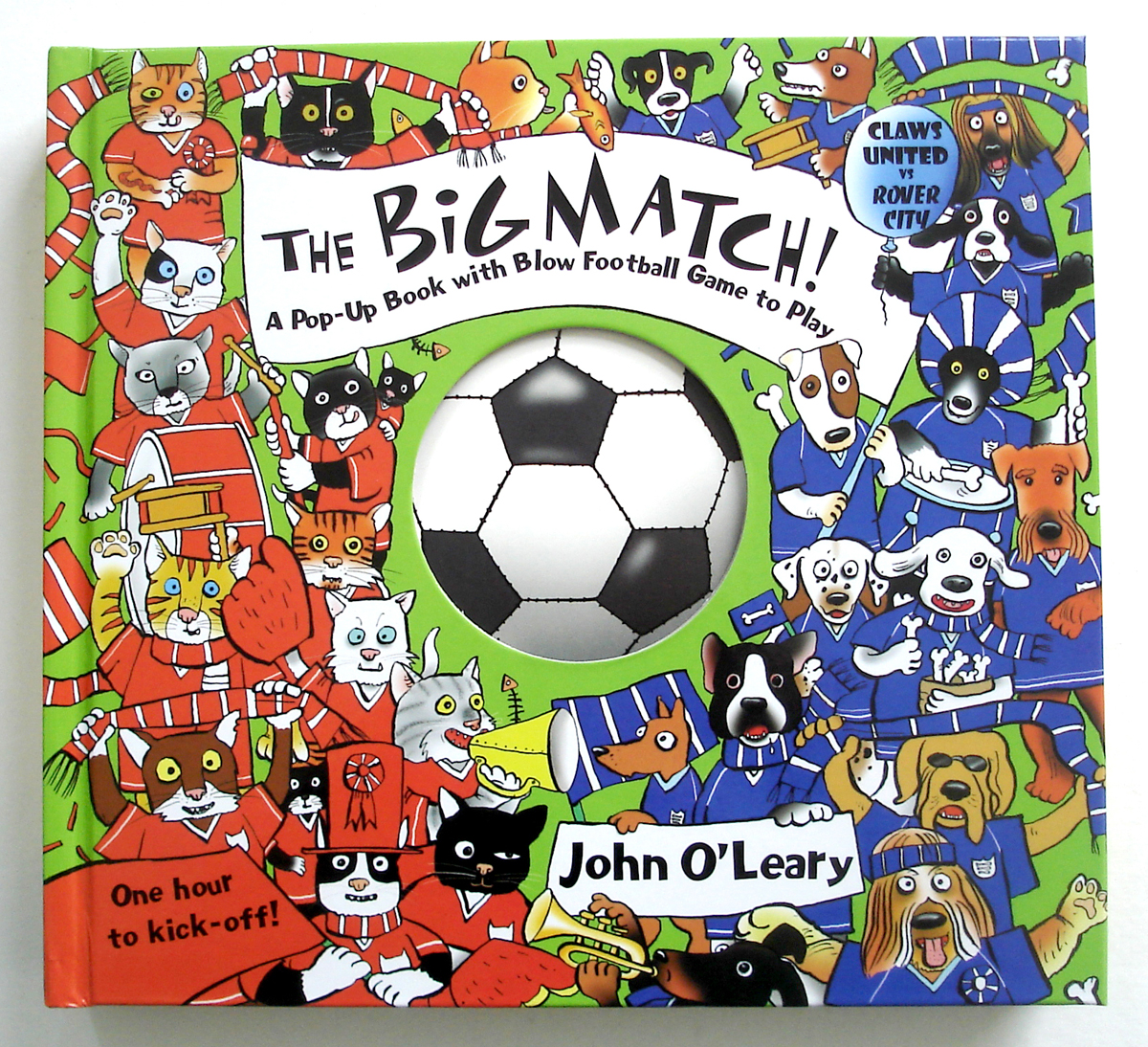 The revised edition of my picture book The Big Match, published by Tango Books, is now out.
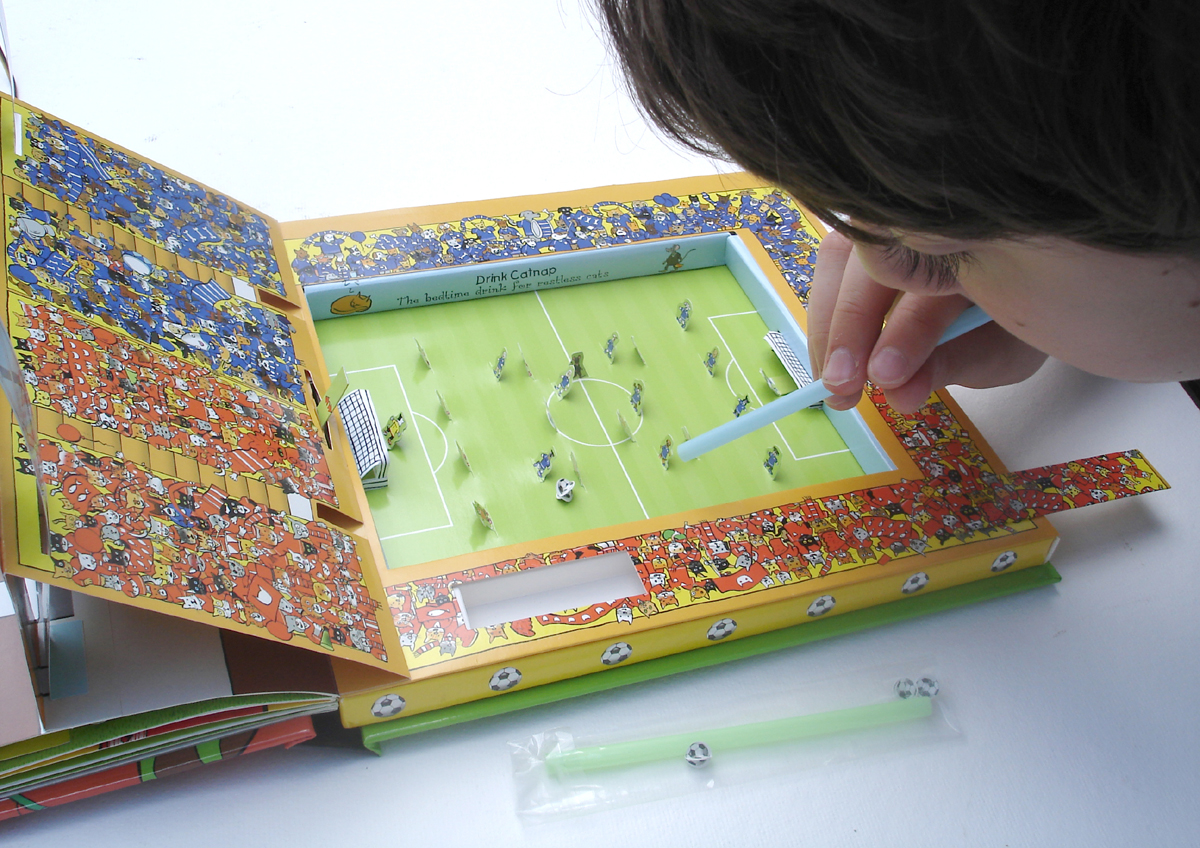
This version has a blow football game at the end, in place of the static electricity game of the original. I loved the magic of the static electricity device and the novelty aspect was enough for me, although some of the buyers and bookshops were confused about how the ‘game’ worked. Having said that, I’m also very happy with the blow football game as an alternative ending and it was also a good excuse for me to add a secret hidden container for the balls and straws.
JOHN O’LEARY
To get copies of the book, contact sales@tangobooks.co.uk or go to Amazon
Alll Fall Down – A story of survival by Sally Nicholls
 There are some things that have always fascinated me.
One is the mystery behind prehistoric stone circles. How were they erected? People have tried to explain, but it remains a mystery to me. Where did they find the big stones and how did they place them so accurately?
Another is whether there really is a Loch Ness Monster. Will I be alive when they discover one?
Relevant to this blog post is how on earth people carried on when everyone around them died, for example during a plague.
When a friend asked me recently what book I was reading, I told her that I was reading All Fall Down – A story of survival by Sally Nicholls. I told her that it is about the Black Death in 1349 and I received a very strange look. I started to burble on about how interesting I found the book. I am not sure that my friend looked convinced.
Sally Nicholls must have done careful research into daily living in those far-off days. She describes the food, the hard toil in the fields that belonged to the lord of the manor, the festivals and the strange superstitions. We learn about the influence of the church. Sally portrays some clergy who did not care much about their flock and abandoned them and yet others who gave their all in trying to say prayers over the dying.
We experience the emotions of these desperate days through the eyes of 13-year old Isabel. She has two older brothers, who have both left home. When her father and stepmother die she has to try and take charge of a younger brother and sister. She is a spirited girl who loves the land.
The story is told in the continuous present, which is not my favourite format, but seems just right for this story. I was propelled to the end, not knowing at all how things would work out. I think the ending is brave. It does not gloss over the horrors people have endured. Above all this story is powerful and thought-provoking.
This is Sally Nicholls’ third book. I have a copy of her first book, Ways to Live Forever which I also heartily recommend. If you decide to read All Fall Down, I hope that like me, despite the inevitable account of human suffering, you will find it beautifully constructed, beautifully written and an inspiring story.
Odette Elliott
I review childre n’s books for the Historical Novel Society and my latest parcel of books to review has just arrived. What have I got this time? It’s always an exciting moment. There are three books.
The first is The Case of the Good-Looking Corpse, Caroline Lawrence’s new P. K. Pinkerton mystery set inVirginia City, a lawless mining town in 1862Nevada. Her twelve-year-old detective hero is a loner who hates being touched, he collects things – for example, over one hundred different sorts of tobacco – he suffers from depression and isn’t good at understanding other people’s emotions. On the other hand, he’s intelligent, brave, tenacious and truthful, and he goes to chapel on Sundays. He’s a sort of autistic Huckleberry Finn – though I doubt Huck would be keen on the chapel on Sunday bit.
The best children’s authors don’t pull their punches. Caroline Lawrence’s young hero frequents low bars, meets ‘soiled doves’ (prostitutes), visits a morgue and experiences a stream of racist abuse (he’s half-Indian) in his search for Sally Sampson’s killer. It’s a terrific read.
 The next book is Stones for my Father by TrilbyKent, set in Dutch South Africa in 1900. Twelve-year old Corlie lives on a farm in theTransvaal, land the British want for the gold nearby. When the farm is torched, Corlie’s family escape, only to be captured and sent to one of the notorious internment camps set up by the British for women and children. TrilbyKent does not soften the horrors of disease, death and semi-starvation. Corlie has much to learn, not only the secret of why her mother hates her but that help and comfort can be found in the most unlikely places.
I’m just about to embark on the third book, City of Swords, the latest in Mary Hoffman’s Stravaganza series. Enter a World of Treachery and Danger shouts the strap line. It’s obviously aimed at teenage girls who like adventure with, perhaps, a touch of romance. Her heroine, Laura, may be able to time-travel to 16th centuryItaly but, as the cover shows, she never forgets her mascara and eyeliner. I always enjoy Mary Hoffman’s books and I’m looking forward to this one.
Children’s books nowadays have got to be a jolly good read. Children are highly discriminating. T hey won’t tolerate being preached at, condescended to, or bored. In the 19th century, children were given books that were good for them. For example, Charles Kingsley’s The Water Babies has characters called Mrs Do-as-you-would-be done-by and Mrs Be-done-by-as-you-did. A Victorian godfather is recorded as giving his goddaughter Charlotte M. Yonge’s The Daisy Chain because he knew it was ‘A safe book for girls’. Those attitudes have gone, thank goodness.
21st century writers of adult novels have to cope with publishers wanting slot their books into a known category: saga, thriller, chick lit, or whatever. Children’s authors are more fortunate; they can write what they want, and the results, as my haul shows, are books that are thrilling, thought-provoking and moving. No wonder there are so many crossover books.
The Public Lending Right (PLR) is the right of author’s to receive compensatory payment for library loans for their print books – and very useful it is too. The money to pay this is funded by the Department of Culture, Media and and Science. The government is currently proposing to abolish the body that administers PLR, and transfer the role to the British Library. A 12-week consultation is happening right now and interested parties should make their views known. What do we think?
The government’s main argument is that cutting down on quangos will save money and provide greater accountability.
Some questions this raises for me are:
Will it actually save money and increase efficiency? By the government’s own say-so the current body is working at maximum efficiency. Where are the figures to show the saving that will be made by transfer to a larger body? Surely the very process of changing over will create costs?
What about the loss of the highly effective skill-set built up by the current small team based in Stockton-on-Tees? The general view is that their service is specialist and exceptional.
One threat appears to be that if more savings can’t be made in admin then the fund available to authors would have to be cut (again). One obvious answer could just be NOT to cut the authors’ fund but to continue to meet the legal commitment to pay for loans.
The proposed thinking is to abolish the Registrar of PLR and transfer the admin to the British Library. Would this new home be sufficiently independent and separate from the influence of the DCMS, currently headed by Jeremy Hunt? This is a very real concern.
The current Registrar of PLR IS independent, efficient, skilled, small, not London-based…
What do other think?
Buzz about Books authors could respond as a group or separately to the government consultation at plr_consultation@culture.gsi.gov.uk
Marion Rose
Mayton Street Festival 2012
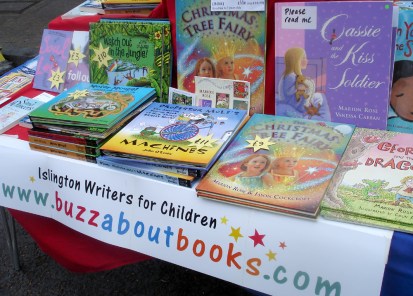
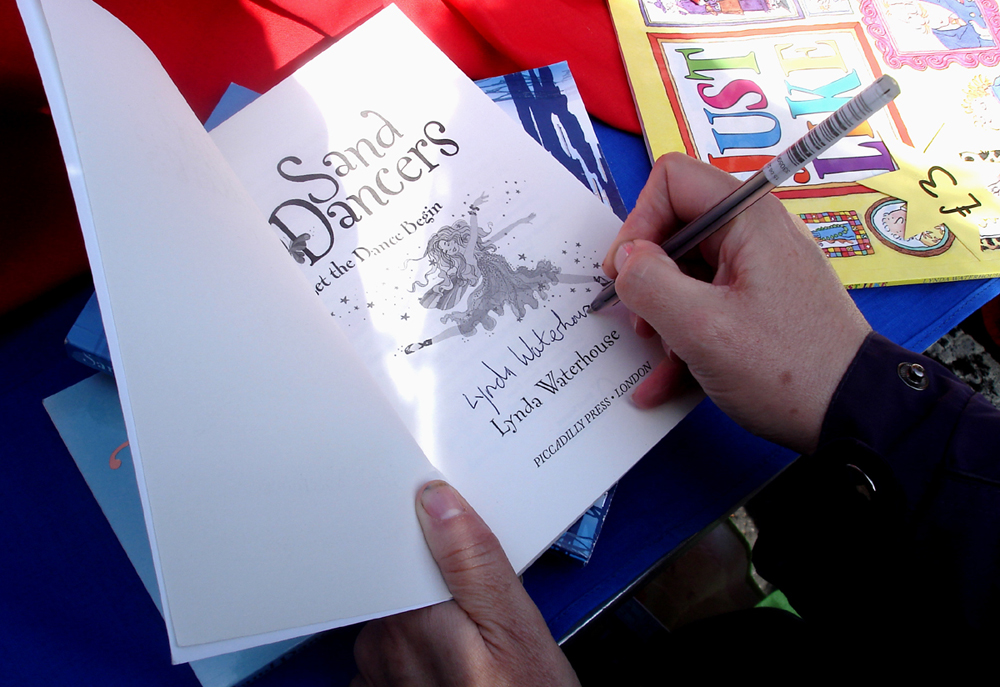
Buzz authors, Marion Rose, Lynda Waterhouse, Judy Cumberbatch and John O’Leary, will be selling and signing at the Mayton Street Festival 2012 (part of Holloway Arts Festival), on Saturday 2 June between 1.00 and 5.30 pm.
Full details of the festival here:
http://www.therowanartsproject.com/maytonstreetfestival2012


And the prize goes to….
ALISON ALLEN-GRAY
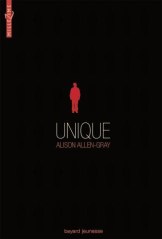 I’ve just heard that my novel Unique came second out of ten teenage novels in Le Prix des Lecteurs du Mans et de la Sarthe. I daren’t ask how many votes separated first from second! However, the real prize was the tremendous buzz I got from going to Le Mans and meeting the French students.
There were many memorable moments during my trip, not least of which was my very first session with a class of 13-15 year-olds in a rural school. As I waited nervously in a classroom, I noted that a rather noisy hiatus was occurring outside in the corridor. The teacher was organising who should sit where, calling back students who had already entered the room, re-directing them and directing the re-arrangement of chairs and tables. I myself was re-arranged and asked to sit at the apex of the horseshoe of tables and chairs. I then gathered that I was to play the part of a Judge in a trial at the European Court.
Unique is a story about Dominic, who discovers that he is the first ever cloned human being. In the novel, there is a global prohibition on human cloning, transgression of which is punishable by the death penalty. Two of my characters – Dr Imogen Holt, who cloned Dominic, and Dominic’s father, Michael Gordon – have therefore taken a huge risk in doing what they do.
The students of this school had developed a ‘what-if’ from the story – that is to say, they had imagined what would happen if the European Court had put Dr Imogen Holt and Dominic’s parents on trial. The result was the courtroom scene at which I was the Judge. I sat enthralled for almost two hours as the students presented defence and prosecution arguments, some of which were emotionally charged and delivered with great passion and commitment. Characters were called as witnesses to tell their side of the story which, again, they did with moving intensity. Soon, I forgot that it is a thousand years since I studied French, and I found myself comprehending the range of complex arguments. I was quite overwhelmed – almost tearful, in fact – not only by the drama of the moment, but by the fact that these students had become so personally involved in the story and had reacted to it in such a thought-provoking way.
In fact, they provoked my thoughts so much that I think I’ll write the sequel that they so sincerely requested! So, although I didn’t win, I’m tremendously heartened by the experience. I gave the students something to think about and they gave me something to think about in return. What more could I ask for?
Inspired by the telamon by Elizabeth Hawksley
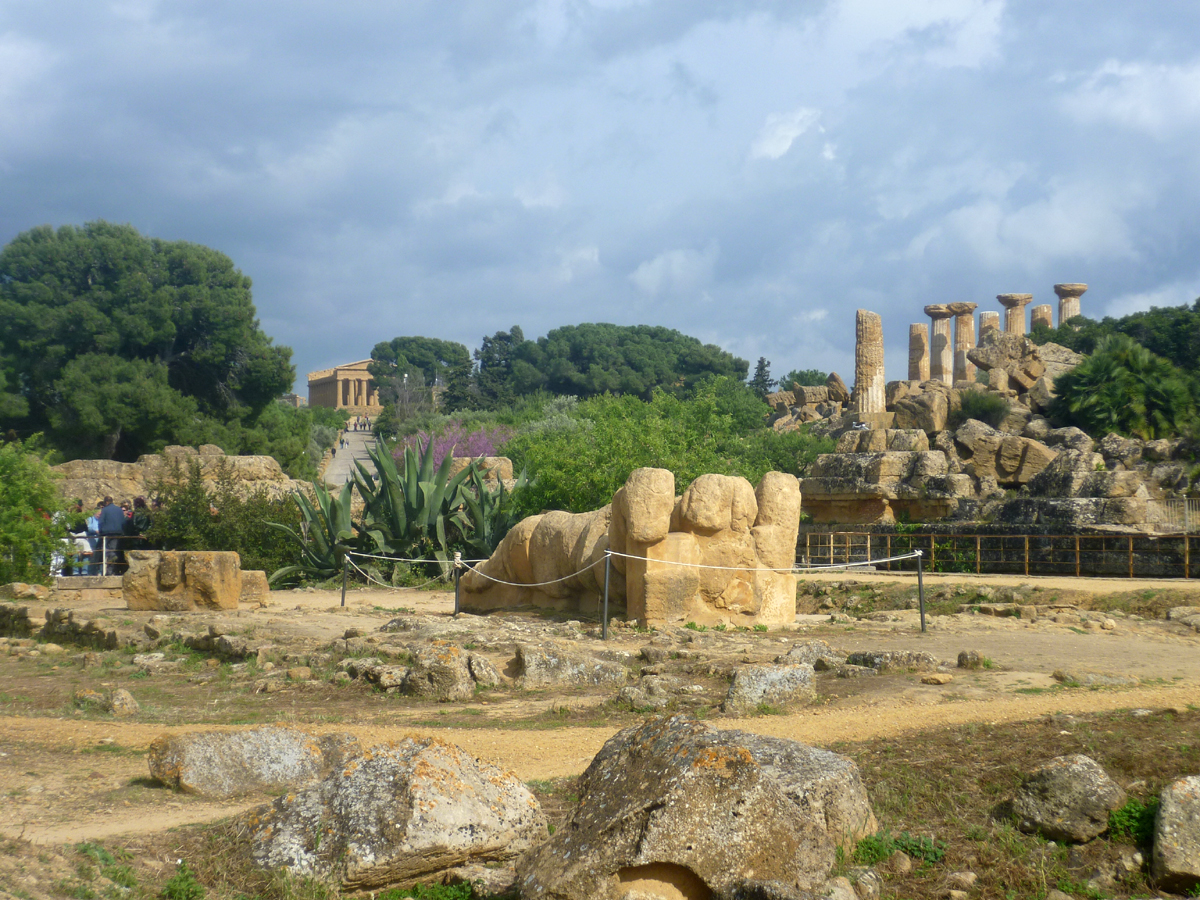
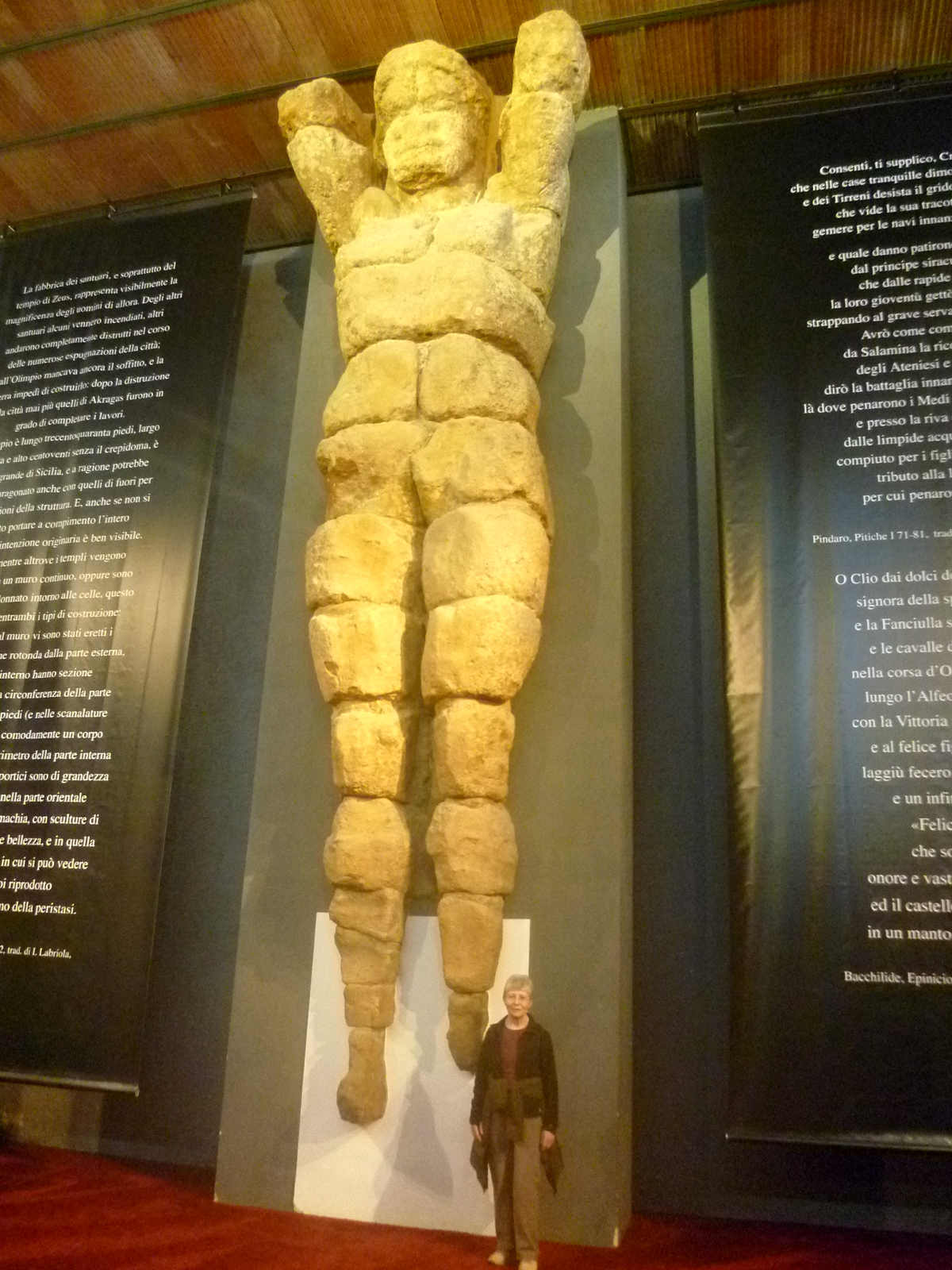 In the 5-6th century B.C., the Greeks of Magna Graecia built a line of impressive temples just outside the city of Akragas (modern Agrigento) inSicily. The largest of all is the temple to Olympian Zeus, and its upper floor was supported by thirty-eight enormous telamones, each over 25 feet tall. Telamones are the male equivalent of caryatids, those draped female figures who masquerade as columns and hold up roofs, the most famous being the caryatids which support the Parthenon.
Telamon is mentioned in Homer’s Iliad as the father of the Greek hero, the greater Ajax. His name means ‘support’ or ‘bearer’ and this is what he does in the temple ofOlympian Zeus. The telemones (plural) were made in sections and it appears that, after two and a half thousand years of weathering, they were not at first recognized for what they were when they lay scattered on the ground after the temple was destroyed by a massive earthquake in 1401.
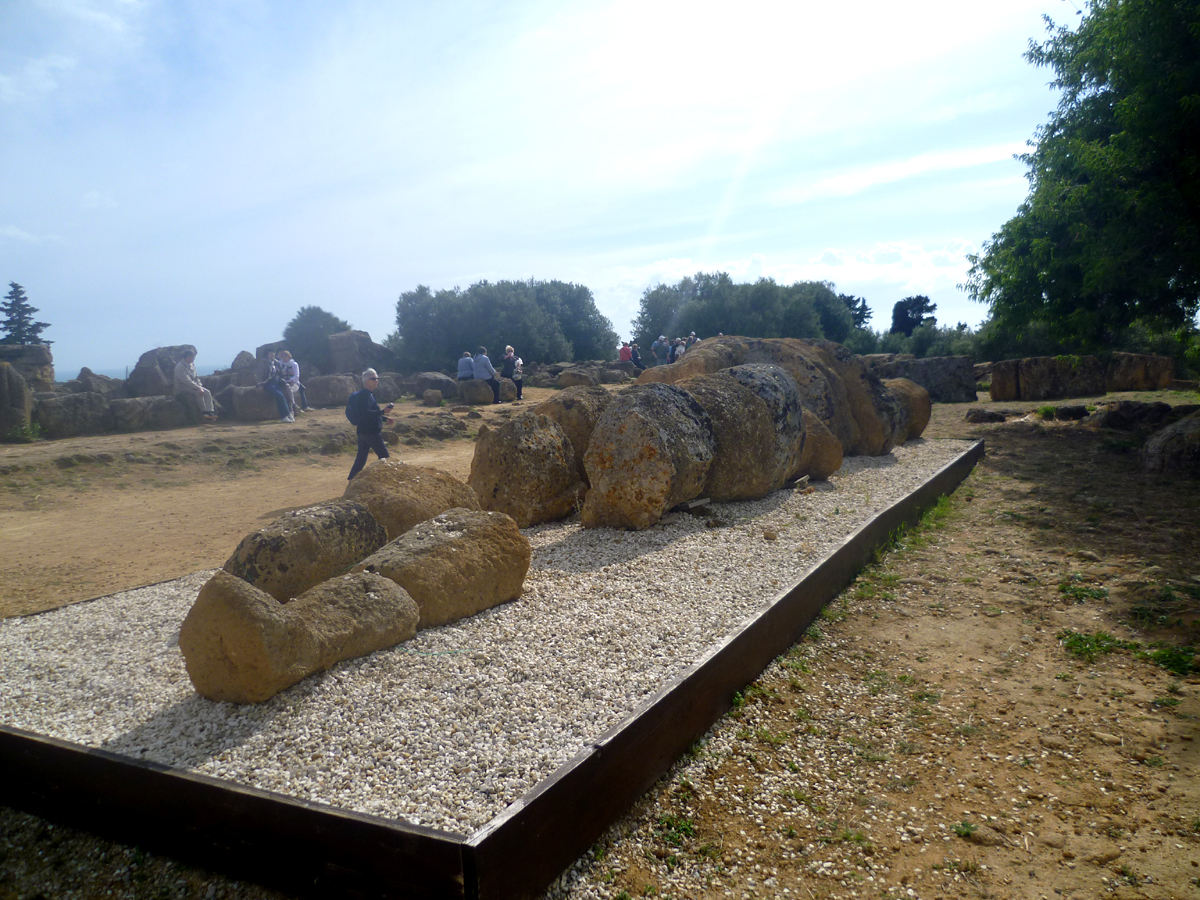
However, once recognized, one was removed to the museum at Agrigento and erected in a specially built room. You can see the height by the woman standing by his feet. Note how small the feet are compared with his huge head and arms – an optical trick to make the figure appear in proportion when viewed from the ground. Recently, another telamon has been recognized and reassembled on the ground beside the fallen temple.
I’m writing about telamones because I want to share my awe. I just stood, jaw-dropped, staring at it like a Liliputian on first sighting Gulliver. I felt that such a gigantic figure, so battered but still recognizable, must have a story. Who was he? Why was he doomed to support the temple for all eternity? Would it be dangerous to rescue him? I wanted to know.
A salute to Maurice Sendak
 …who died this week. ‘Where the Wild Things Are’ will surely live for as long as there are picture books. I think it hasn’t aged in the fifty years since it first appeared. It still looks – and sounds – edgy, alternative and distinctive. In a very few, understated words it evokes a strange adventure, an emotional journey, and a dark, wild place of the soul that readers of all ages ‘get’. What a gift.
I have sometimes tried to write picture books about kids’ rage or anger, but WTWTA always says it better. And the ‘it’ that it says, is so grounded and wise. I bought my copy when I first started writing for children, and for me, it is still a masterclass in picture book writing. (I wonder what books other people feel this way about?) Anyway, I take off my scribbler’s hat to Maurice Sendak. He may have gone into the night of his very own room, but what he leaves behind is still hot.
Marion Rose
It’s a Fold Up
I worked in a school recently where the children surprised and delighted me with their paper engineering skills.
 I was running a two-day session at St Agnes RC Primary in Cricklewood and decided to give the year 3 and 4 pupils a special task. Handing them two giant, collapsible frameworks made from cardboard, I gave them a very brief set of instructions before sending them away to start work.
When I caught up with them at the end of day two for the showing assembly, I was quite moved when the pop-ups were revealed. Not only had they managed to work together as teams to produce two pieces that held together very well visually, but they also amazed me by how they had successfully combined a variety of materials and came up with a great many innovative ideas to enhance the pop-ups. And both pieces still folded flat!
Read more about the sessions at N4 Sketchpad
JOHN O’LEARY

Afraid to offend?
NIKKI BIELINSKI
Did anyone else see the David Walliam’s TV show on Roald Dahl? (ITV, Sunday 22/4/12) I enjoy the work of both, loving the in-your-face, boundary crossing humour that is very refreshing. I am often struck, however by the dearth of female writers in hard-hitting, not-afraid-to-offend, provocative humour. I’ve noticed, also, the small number of successful female stand-up comedians in comparison to the number of successful males. Why is this?
My own take on it is the socialisation process. Girls are taught to ‘be a good girl’, ‘nice girls don’t say things like that’, etc. I think this leads many females to seek approval. How can we be fiercely funny, unafraid to offend, when our basic, socially conditioned drive is to protect the feelings of others?!
Little boys. ‘He is so cheeky,’ parents say lovingly – where they may reprimand their daughter for doing the same thing. ‘Go on, get out there, tell them what you really think’.
Is it possible to break down years of social conditioning, not be afraid to offend, and chance that desire for approval to get the laughs?
 Buzz about Books